



Choosing a custom clothing manufacturer is a commercial decision that affects more than the first production run. The right partner can help you turn a product idea into a repeatable garment with consistent fabric, fit, decoration, packaging, and quality. The wrong supplier may create delays, unclear costs, uneven sizing, or bulk goods that do not match the approved sample. This guide explains how clothing brands, apparel startups, sourcing teams, retailers, clubs, schools, and organizations can evaluate a manufacturing partner before committing to private label or bulk apparel production.
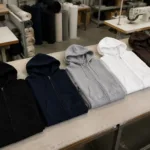
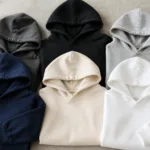
If your project involves branded sweatshirts, teamwear, or seasonal fleece products, custom hoodie development and bulk production support can help connect fabric selection, pattern refinement, decoration, labels, sampling, and production planning into one practical process. At Ninghow, we use the same evaluation logic across hoodies and other garment categories so buyers can clarify requirements before sampling and reduce avoidable production risk.
Why the Manufacturer You Choose Affects Brand Growth
A manufacturer influences the product experience that customers see and feel. Fabric weight, softness, recovery, seam construction, collar shape, shrinkage, print durability, and packaging all contribute to whether a garment appears reliable. These details also affect returns, customer complaints, reorder confidence, and the cost of correcting problems after delivery.
Manufacturing capability should therefore be evaluated against your product requirements rather than judged only by a low quotation. A supplier that is suitable for basic blank T-shirts may not be equipped for engineered sportswear, complex embroidery, garment dyeing, bonded seams, or multi-color private label packaging.
Key takeaway: Select a manufacturer for repeatable technical capability, communication quality, and production control—not just for the lowest first-order price.
What a Custom Clothing Manufacturer Can Actually Provide
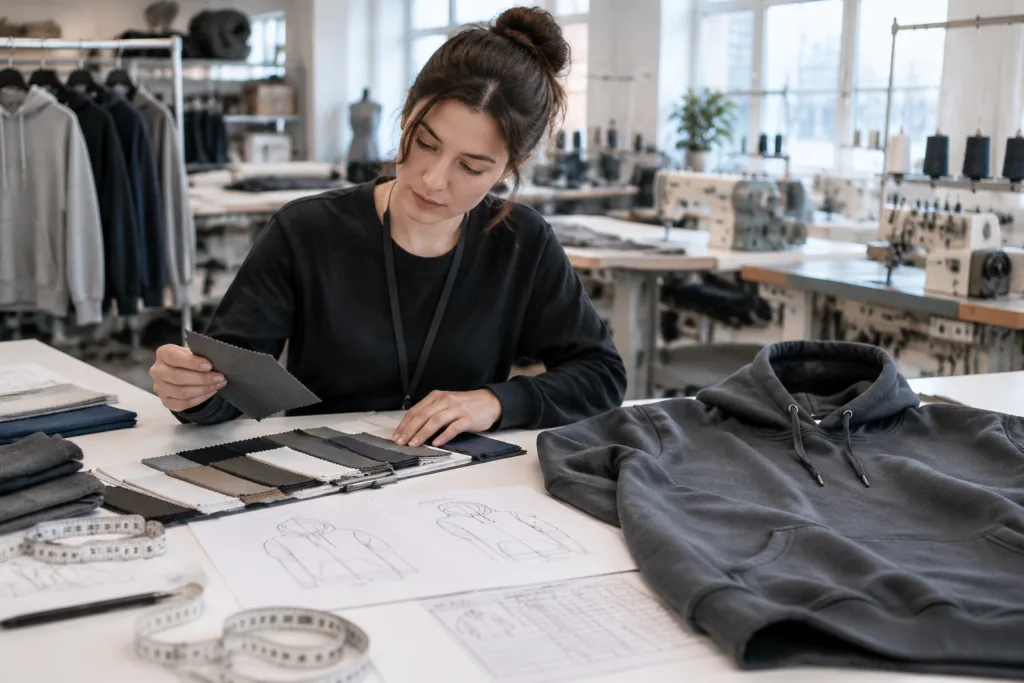
A capable custom clothing manufacturer may support one or several stages of apparel development. Before requesting a quote, identify whether you need a finished custom product, a modified existing style, or a complete cut-and-sew program.
- Custom cut-and-sew production: fabric is sourced or developed, patterns are created, panels are cut, and the garment is sewn to your specifications.
- OEM production: you provide the design direction, technical information, or product brief, and the factory manufactures the product to those requirements.
- ODM development: the supplier may offer existing product foundations or design support that can be adapted for your brand.
- Private label services: woven labels, printed labels, hangtags, care labels, packaging, and branded finishing are added to the garment.
- Sampling and product development: patterns, prototypes, fit samples, decoration samples, and pre-production approvals are coordinated before bulk production.
Ask which services are performed in-house and which are coordinated through outside partners. Outsourcing is not automatically a problem, but it should be transparent because it can affect lead time, communication, quality responsibility, and minimum order quantities.
Custom Manufacturing, OEM, ODM, and Private Label Compared
| Production route | Best suited to | Buyer responsibility | Main evaluation point |
|---|---|---|---|
| Custom cut-and-sew | Distinctive products and original fits | Detailed design and technical decisions | Pattern, fabric, and construction expertise |
| OEM | Brands with defined specifications | Tech pack, approvals, and standards | Ability to manufacture accurately |
| ODM | Faster development from existing foundations | Brand direction and customization choices | Adaptability and design ownership |
| Private label | Branded garments using a chosen product base | Labels, packaging, and brand assets | Finishing control and minimum quantities |
These terms can overlap, so request a written description of what is included. A supplier may call a service “private label” while offering only a neck label, whereas your project may also require custom hangtags, barcode stickers, polybag warnings, carton marks, and retail-ready packaging.
Define Your Product Requirements Before Contacting Manufacturers
The strongest supplier conversations begin with a clear product brief. You do not need to know every production detail, but you should define the garment’s purpose, target customer, expected retail position, estimated order volume, and performance requirements.
- Garment category, intended use, season, and target market
- Reference images, sketches, or an existing garment for comparison
- Target fabric composition, hand feel, stretch, breathability, and durability
- Preferred color standards and approximate number of colorways
- Size range, fit direction, and measurement priorities
- Logo locations, artwork files, labels, hangtags, and packaging needs
- Expected first order, reorder potential, and launch date
- Required testing, inspection, labeling, or compliance documentation
This information helps a manufacturer separate essential requirements from optional details. It also makes quotations easier to compare because each supplier is responding to a similar scope.
Choose the Right Garment Category and Production Method
Start by matching the supplier’s experience to the garment you plan to sell. A manufacturer that regularly produces fleece hoodies may understand brushed-back construction, kangaroo pockets, rib recovery, drawcord finishing, and heavy fabric handling. A supplier focused on lightweight activewear may be stronger in stretch fabrics, flat seams, moisture management, and sublimation.
For T-shirts, examine neck rib stability, shoulder taping, side seams, fabric spirality, and post-wash appearance. For polo shirts, review collar construction, placket alignment, button quality, and color consistency between the body and trims. For sportswear, evaluate stretch recovery, panel placement, seam comfort, and decoration performance during movement.
At Ninghow, we recommend asking for examples of products that are technically similar to your intended garment, not merely products that look similar in photographs. Similar fabric weight, stitch density, fit complexity, and finishing requirements are more useful indicators of production fit.
How to Evaluate Fabric Composition, GSM, and Performance
Fabric selection should balance customer expectations, garment use, appearance, durability, and cost. Composition tells you what fibers are present, while GSM indicates fabric weight. Neither measurement alone fully describes quality. Two fabrics with the same composition and GSM can feel different because of yarn, knitting, finishing, dyeing, and construction.
| Fabric factor | What it affects | Questions to ask |
|---|---|---|
| Fiber composition | Hand feel, care, breathability, recovery, and price | Is the composition verified and appropriate for the use? |
| GSM | Perceived weight, opacity, warmth, and drape | Is the GSM measured consistently after finishing? |
| Stretch and recovery | Comfort, fit retention, and movement | Will the fabric return to shape after wear and washing? |
| Finishing | Softness, surface appearance, shrinkage, and color | What finishing process will be used and controlled? |
| Color performance | Brand consistency, rubbing, washing, and appearance | How are lab dips and bulk color approvals documented? |
If organic fibers are important to your product positioning, compare documentation, source availability, dyeing options, and order quantities rather than assuming that a fiber claim automatically defines the whole garment. Buyers evaluating this route can review organic cotton apparel manufacturing options while also confirming fabric composition and certification requirements with the supplier.
Dimensional stability deserves particular attention. Shrinkage and skewing can change measurements, side seam alignment, and the overall appearance after washing. Technical guidance on garment shrinkage and dimensional stability testing reinforces why wash-test results should be compared with the approved measurement specification before bulk approval.
Fit, Sizing, Pattern Development, and Grading
A garment can use excellent fabric and still fail if the fit is inconsistent. Ask how the manufacturer develops the base pattern, records measurements, grades between sizes, and checks tolerances during production. A grading rule that works for a relaxed hoodie may not work for a fitted T-shirt or performance top.
Provide a measurement chart with points of measure, tolerance expectations, and clear instructions. If you have a physical reference garment, specify whether it should be copied exactly or used only as a general fit reference. Also state whether measurements apply before washing, after washing, or at a defined stage of finishing.
- Confirm chest, body length, shoulder, sleeve, armhole, hem, and neck measurements.
- Define whether the fit is slim, regular, relaxed, oversized, cropped, or performance-oriented.
- Check how rib, elastic, drawcords, and stretch panels affect finished measurements.
- Review the full size range rather than approving only the base size.
- Compare samples on a suitable fit model or through a controlled measurement review.
Prepare a Useful Tech Pack or Product Brief
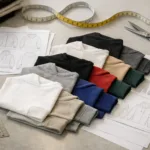
A tech pack reduces interpretation gaps between your team and the factory. It should combine visual references with measurable instructions. Useful contents include flat sketches, artwork placement, bill of materials, fabric details, color references, measurement charts, seam notes, label positions, packaging requirements, and approval procedures.
If you do not have a complete tech pack, provide a structured product brief and ask the manufacturer to identify missing decisions before sampling. It is better to resolve ambiguity at this stage than after fabric has been ordered or patterns have been cut.
Keep one controlled version of the specifications. When a measurement, logo size, color, or trim changes, record the revision date and approval status. This prevents a factory from working from an outdated file and gives both parties a clear basis for resolving discrepancies.
Compare Labels, Packaging, Printing, and Embroidery
Customization affects appearance, production planning, and cost. Woven labels, printed care labels, hangtags, stickers, cartons, and polybags should be specified early because trims may have their own minimum quantities and production times.
| Decoration method | Strengths | Important limitations | Best evaluation question |
|---|---|---|---|
| Embroidery | Durable, dimensional, and suitable for polos, caps, and heavier garments | May add weight, stiffness, or detail limitations | Does the artwork need simplification or backing? |
| Screen printing | Efficient for bold graphics and larger quantities | Color count, hand feel, and placement affect cost | How will ink coverage and curing be controlled? |
| Heat transfer | Useful for detailed graphics and smaller runs | Film quality, adhesion, and wash durability vary | What test confirms durability on this fabric? |
| Sublimation | Suitable for polyester and all-over sports graphics | Usually unsuitable for cotton and dependent on base fabric | How will color and placement be matched? |
Artwork should be supplied in the requested format with clear dimensions and placement references. A decoration sample or strike-off is valuable because the same logo can look different on fleece, rib, pique, jersey, and stretch fabric.
Color-sensitive programs may also need a controlled dyeing plan. For example, custom fabric dyeing for consistent hoodie colors is easier to manage when the buyer confirms lab dips, approved standards, lighting conditions, and bulk shade tolerances before production.
Use Sampling to Validate the Product Before Bulk Production
Sampling is not a formality; it is the point at which design assumptions become measurable product decisions. A normal development path may include an initial prototype, a fit sample, a revised sample, a decoration approval, and a pre-production sample. The number of rounds depends on product complexity and how complete the original information is.
Evaluate more than visual appearance. Measure the sample, inspect seams and trims, test the logo application, assess fabric hand feel, and wash the garment when shrinkage or color performance matters. Record comments in one approval document so the factory can distinguish required corrections from optional preferences.
Our detailed apparel sampling and fit validation approach reflects a central manufacturing principle: bulk production should not begin while fit, fabric, decoration, and packaging decisions remain unresolved.
Key takeaway: A signed or otherwise documented pre-production approval should identify the exact sample, measurements, materials, artwork, colors, and finishing details that bulk production must follow.
Assess Technical Capability, MOQ, and Scalability
Minimum order quantity is rarely a single universal number. It may apply per style, color, fabric, size ratio, or decoration. Custom-dyed fabric, special trims, unusual colors, and complex packaging can raise the practical MOQ even when the sewing line could produce a smaller quantity.
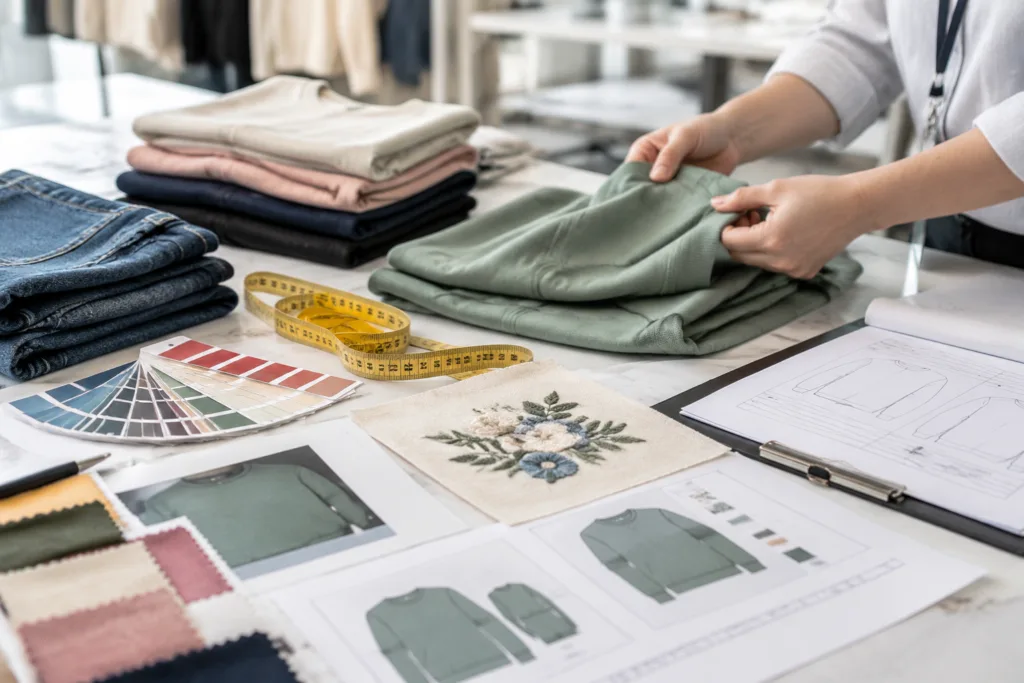
Ask the manufacturer to explain the MOQ assumptions behind the quotation. A lower MOQ may be realistic when using available fabric, standard trims, existing colors, or a simpler decoration method. It may be less realistic when every color requires new fabric development and separate label or packaging orders.
| MOQ variable | Why it matters | Planning response |
|---|---|---|
| Fabric availability | Stock fabric may support smaller programs than custom production | Ask whether the fabric is stocked, reserved, or newly developed |
| Colorways | Each color can create separate dyeing or purchasing requirements | Prioritize launch colors and confirm minimums per color |
| Size range | Small quantities spread across many sizes can reduce efficiency | Prepare a realistic size ratio and forecast reorders |
| Trims and packaging | Labels, bags, and boxes may have supplier minimums | Confirm leftover trim ownership and storage options |
| Production line | Complex styles require setup and balancing time | Ask how the factory schedules small and repeat orders |
Scalability means more than claiming a large monthly capacity. Ask whether the same fabric, pattern, sewing method, and inspection process can be repeated for a reorder. A supplier should be able to explain how it manages capacity during busy periods and how it protects approved standards when production volume increases.
Understand Pricing and Hidden Production Costs
Compare quotations line by line. Unit price may exclude sampling, pattern fees, fabric testing, custom dyeing, embroidery digitizing, screen setup, labels, packaging, inspection, freight preparation, or special cartons. A low price is not useful if key requirements are omitted and added later.
- Fabric and trim costs, including development or color surcharges
- Pattern making, grading, sampling, and revision fees
- Decoration setup, artwork conversion, and testing
- Labels, hangtags, barcodes, bags, cartons, and shipping marks
- Inspection, rework, replacement, and packing requirements
- Payment terms, currency assumptions, and quotation validity
Request the same product specification from each supplier and ask for assumptions in writing. When comparing total cost, include the likely cost of defects, delays, extra freight, and excess inventory. Cost-performance balance is more useful than unit price alone.
Confirm Lead Times and Production Milestones
Lead time should be divided into stages rather than presented as one optimistic number. A practical schedule may include material confirmation, lab dips, trim production, pattern development, sampling, buyer approval, bulk fabric production, cutting, sewing, decoration, inspection, packing, and dispatch preparation.
Ask which events start the clock. Some suppliers count from deposit, while others count from final approval of all materials. Confirm what happens if an approval is late, a lab dip is rejected, or a fabric fails inspection. This makes the schedule more realistic and gives your team clear decision deadlines.
| Milestone | Buyer approval to confirm | Potential delay risk |
|---|---|---|
| Material approval | Composition, GSM, hand feel, color, and test expectations | Unavailable or inconsistent fabric |
| Sample approval | Fit, measurements, construction, and decoration | Repeated revisions or unclear comments |
| Pre-production approval | Bulk materials and workmanship standard | Bulk differs from development sample |
| Final inspection | Defect tolerance, measurements, packing, and quantity | Rework or incomplete packing |
Evaluate Quality Control and Production Transparency
Quality control should be built into the process, not left to a final visual check. Ask how the supplier inspects incoming fabric, controls spreading and cutting, checks sewing operations, verifies measurements, reviews decoration, and confirms packing quantities.
For branded garments, color and decoration deserve documented checks. Ask what colorfastness testing is performed, which laundering conditions are used, and how results are recorded. The ISO textile colorfastness testing reference provides useful context for why standardized laundering methods can make results more meaningful than an informal wash check.
For dimensional control, compare post-wash measurements with the approved size chart and establish tolerances before production. For construction, inspect seam strength, skipped stitches, puckering, loose threads, zipper function, pocket alignment, rib attachment, and label placement.
At Ninghow, we treat inspection criteria as part of the product specification. Buyers can also review apparel quality control for shrinkage and colorfastness when preparing a risk-based inspection plan for branded garments.
Assess Communication, Documentation, and Compliance
Good communication is specific, timely, and documented. A reliable manufacturer should be willing to clarify assumptions, identify risks, confirm revisions, and explain what information is needed before production. Fast replies are useful, but accurate written records are more important.
- Is there one accountable project contact?
- Are quotations itemized and dated?
- Are sample comments recorded and confirmed?
- Can the supplier provide production photos or milestone updates when appropriate?
- Are labeling, packaging, testing, and destination-market requirements understood?
- Is responsibility clear when a material or workmanship issue occurs?
Compliance requirements depend on the destination market, product type, fiber claims, labeling, chemicals, packaging, and customer standards. Do not assume that a general compliance statement covers your specific order. Define the required documents and tests before bulk production.
Questions to Ask Before Selecting a Manufacturer
Use direct questions to reveal how a supplier thinks about risk and execution:
- Which garment categories and fabric constructions do you produce regularly?
- What is included in your sampling and pattern development service?
- How do you calculate MOQ by style, color, fabric, and size?
- Which materials and trims are stocked, and which require custom development?
- How do you control shrinkage, skewing, shade variation, and measurement tolerances?
- Can you provide a written production schedule with approval milestones?
- How are embroidery, printing, labels, and packaging approved?
- What inspection records are available before shipment?
- How do you handle defects, rework, shortages, or late delivery?
- What information do you need from us before quoting accurately?
Warning Signs of an Unreliable Apparel Supplier
Be cautious when a supplier avoids technical questions, gives a price without reviewing the specification, promises every capability without examples, or refuses to explain MOQ assumptions. Unclear answers at the quotation stage usually become larger problems after deposit and material commitment.
Other warning signs include inconsistent company information, pressure to approve bulk production without a representative sample, unexplained substitutions, missing measurement records, and a reluctance to document changes. A supplier does not need to agree to every request, but it should explain limitations and propose workable alternatives.
Compare Quotes on More Than Unit Price
Create a comparison sheet that scores each manufacturer against the same criteria. Suggested categories include product capability, fabric knowledge, sample quality, technical communication, MOQ fit, customization range, quality controls, lead-time credibility, documentation, and total landed cost.
Weight the criteria according to your project. For a startup with limited inventory, MOQ flexibility and sampling discipline may matter most. For a team uniform program, color consistency, size coverage, replenishment, and delivery reliability may carry greater weight. For a premium private label, fabric hand feel, construction, labels, packaging, and repeatability should receive more attention.
We recommend keeping a written record of assumptions behind every quote. This makes it easier to identify whether one supplier is genuinely more competitive or simply excluding services that another supplier has included.
Prepare for Bulk Production
Before issuing a purchase order, confirm the final specification, approved sample reference, color standards, size ratio, quantities, packaging instructions, inspection standard, payment schedule, and delivery terms. Make sure the supplier has the latest artwork and label files, not files copied from an earlier development stage.
- Approve fabric, trims, lab dips, artwork, and packaging samples.
- Confirm the final measurement chart and tolerance policy.
- Record quantities by color and size.
- Define acceptable defects and the inspection method.
- Confirm carton marks, polybag instructions, and packing ratios.
- Agree on how changes require written approval.
A pre-production meeting or written production confirmation can prevent small misunderstandings from spreading across thousands of garments. If your project involves several colorways or decoration methods, review each variation rather than assuming that approval of one version covers every version.
Common Buyer Mistakes That Cause Delays or Defects
- Choosing by price alone: the quote may exclude essential development, testing, or packaging work.
- Approving a sample without measuring it: visual appearance cannot confirm grading or dimensional accuracy.
- Changing artwork late: new screens, embroidery files, or transfer films can affect both cost and schedule.
- Ignoring wash performance: shrinkage, skewing, fading, and print failure often appear after laundering.
- Launching too many colorways: fragmented quantities can increase MOQ pressure and inventory risk.
- Using vague terms such as premium or heavyweight: measurable composition, GSM, dimensions, and construction details are clearer.
- Skipping the pre-production approval: bulk goods may follow an outdated pattern or unapproved material.
A Practical Manufacturer Evaluation Checklist
Before selecting a partner, confirm that you can answer the following questions with evidence rather than assumptions:
- Can the manufacturer produce the garment category, fabric type, fit, and decoration required?
- Are composition, GSM, color, shrinkage, and performance expectations documented?
- Has the sample been measured, tested, reviewed, and formally approved?
- Are MOQ conditions clear for styles, colors, sizes, fabrics, and trims?
- Does the quotation include development, customization, packaging, inspection, and other relevant costs?
- Is the production schedule divided into clear milestones?
- Are quality checkpoints defined for fabric, construction, measurements, color, decoration, and packing?
- Can the supplier support repeat orders with consistent materials and specifications?
- Are communication responsibilities, compliance documents, and corrective actions clear?
- Does the overall partnership fit your current volume and future growth plan?
Key takeaway: The best manufacturing decision is the one that gives your team confidence in what will be made, how it will be checked, when it will be ready, and how consistently it can be repeated.
Conclusion: Choose for Consistency and Scalable Production
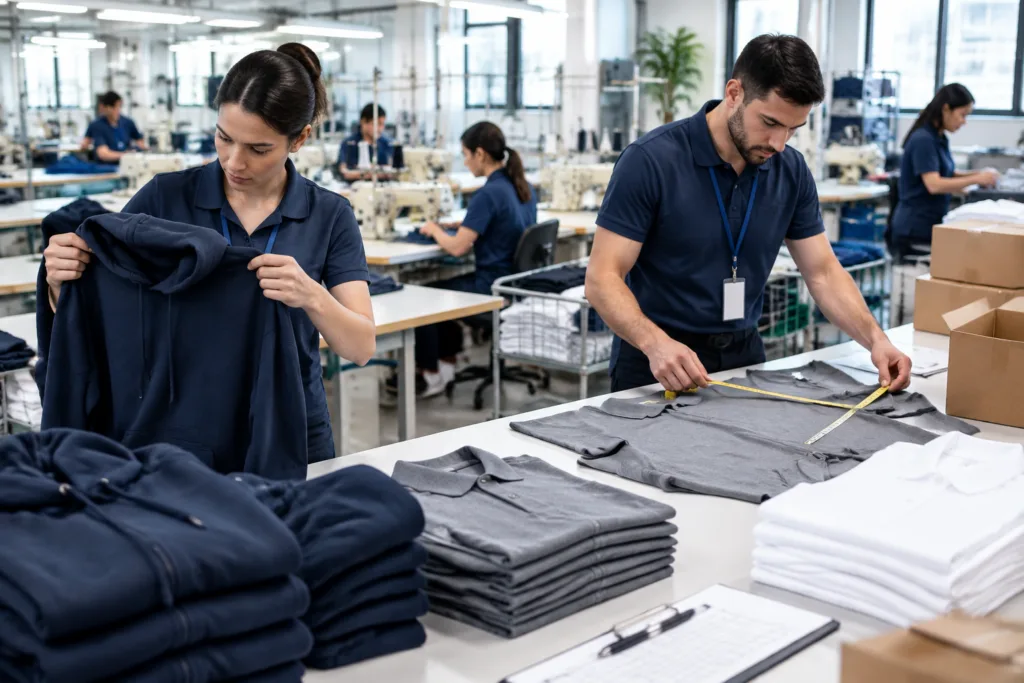
Choosing a custom clothing manufacturer requires a structured review of product capability, fabric expertise, fit development, customization, sampling, MOQ, price, lead time, quality control, communication, and scalability. A manufacturer should be able to explain not only what it can make, but also how it will control the details that matter to your customers.
Prepare a clear brief, ask measurable questions, compare complete quotations, and approve a representative pre-production sample before bulk manufacturing. From our manufacturing perspective, these steps create a stronger foundation for private label development, reliable first orders, and repeat production. Ninghow supports this type of decision-making by connecting product development, sampling, customization, production planning, and quality review in one practical workflow.
Frequently Asked Questions
What should I look for in a custom clothing manufacturer?
Look for proven capability in your garment category, clear fabric and fit knowledge, disciplined sampling, transparent MOQ and pricing logic, documented quality controls, realistic lead times, and responsive written communication. Ask for technically similar product examples and confirm how the supplier manages reorders.
How early should I contact a manufacturer before a bulk apparel launch?
Contact a manufacturer early enough to allow time for specification review, fabric and trim sourcing, sampling, revisions, approvals, and production scheduling. The required time varies by garment complexity and material availability, so ask for a milestone-based schedule rather than relying on one general lead-time estimate.
Is a low MOQ always better for an apparel startup?
A low MOQ can reduce inventory risk, but it may involve standard fabrics, fewer colors, simpler trims, or a higher unit cost. Compare the minimum quantity with your launch forecast, size distribution, color strategy, reorder plan, and the cost of holding excess stock.
Why is a pre-production sample important?
A pre-production sample confirms that the bulk materials, pattern, measurements, construction, decoration, colors, and finishing match the approved requirements. It gives the buyer and manufacturer a final reference before cutting and sewing begin, which can reduce costly corrections later.
How can I compare apparel manufacturer quotes fairly?
Compare quotes using the same specifications and check whether each price includes fabric, trims, sampling, pattern work, decoration, labels, packaging, inspection, and delivery-related preparation. Evaluate total production risk and expected repeatability, not only the listed unit price.
What quality checks should be completed before shipment?
Before shipment, check quantities, measurements, workmanship, fabric and color consistency, decoration placement and durability, shrinkage or wash performance where relevant, labels, packaging, carton marks, and visible defects. Define tolerances and inspection responsibilities before production starts.