







Choosing between domestic vs overseas clothing manufacturers is a commercial decision, not simply a question of geography. The right option depends on your product complexity, target retail price, order volume, launch deadline, communication needs, and tolerance for inventory and logistics risk. A nearby factory may offer faster feedback and shorter replenishment routes, while an overseas manufacturer may provide broader material access, stronger specialization, or more competitive production economics.
For brands, the important comparison is not the quoted unit price alone. You need to evaluate total landed cost, minimum order quantity, sampling speed, quality-control systems, customs requirements, lead time, and the supplier’s ability to adjust when demand changes. This guide provides a practical framework for making that decision based on your actual product and operating model.
If you are still defining your supplier requirements, review the core factors in choosing a clothing manufacturing partner before comparing locations. A clear assessment of capabilities, communication, sampling, quality systems, and commercial terms makes the domestic-versus-overseas decision much more reliable.
What Do Domestic and Overseas Clothing Manufacturers Mean?
Domestic manufacturing generally means producing garments in the same country where the brand sells them or where its main team operates. Overseas manufacturing means working with a factory in another country, usually involving international freight, customs clearance, import documentation, and longer physical supply routes.
These categories are useful, but they are not absolute indicators of quality or suitability. Domestic factories can vary widely in equipment, capacity, product specialization, and pricing. Overseas manufacturers can also range from small development-focused workshops to large factories with dedicated production, technical, and quality teams.
The more useful question is whether a factory is a strong fit for your product and order profile. Location affects operating conditions, but manufacturing capability, process control, responsiveness, and planning discipline often have a greater effect on the final result.
Why the Best Choice Depends on Product Fit
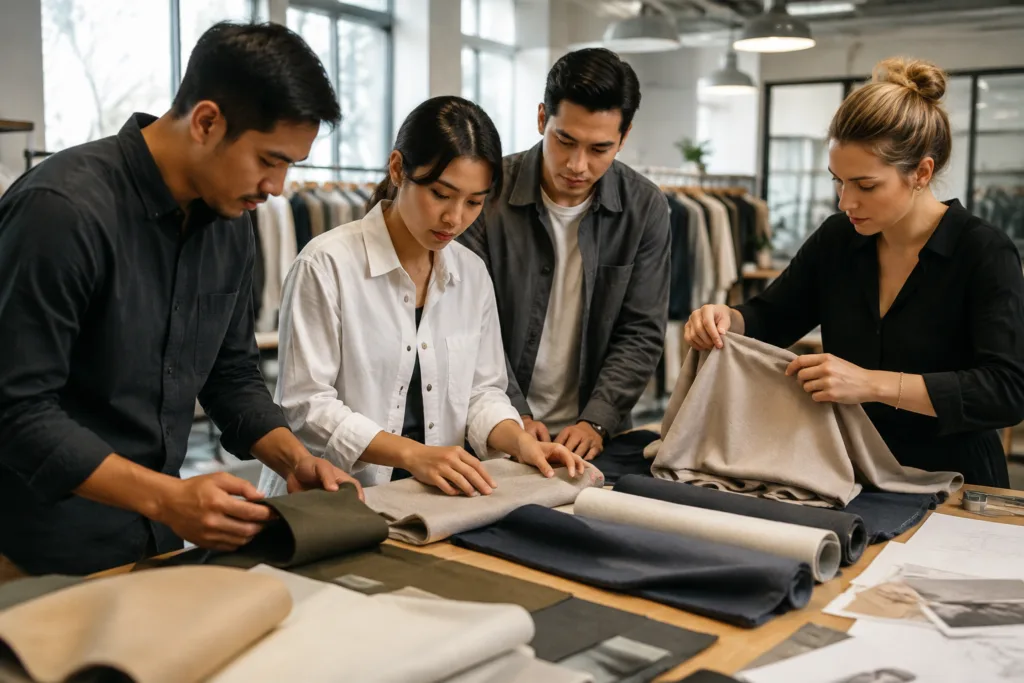
There is no universal winner in a domestic versus overseas manufacturing comparison. A startup making a small test run of a complicated jacket may value local access and quick revisions more than a low factory price. A brand ordering a repeatable basic T-shirt in large quantities may prioritize fabric availability, production efficiency, and total landed cost.
From our manufacturing perspective, we recommend evaluating the following factors together:
- Target retail price and acceptable landed cost
- Initial order quantity and expected reorder volume
- Garment construction, trims, and decoration methods
- Required sample and production timeline
- Communication style and technical documentation
- Quality-control expectations and inspection access
- Forecast accuracy and need for supply-chain flexibility
- Import, labeling, testing, and compliance requirements
Key takeaway: Choose the manufacturing model that reduces the biggest risk in your project. For some brands that risk is price; for others it is delayed delivery, inconsistent quality, excess inventory, or slow product iteration.
How to Compare the Real Cost of Domestic and Overseas Production
Overseas production often appears less expensive when buyers compare factory unit prices. That comparison is incomplete because the final cost may include international freight, insurance, duties, tariffs, customs brokerage, currency movement, port handling, warehousing, and additional inspection or coordination expenses.
Domestic manufacturing may have a higher quoted labor or factory price, but a shorter delivery route can reduce freight complexity and working-capital exposure. Faster replenishment may also allow a brand to place smaller, more frequent orders instead of committing to a large seasonal quantity.
When estimating overseas landed cost, include tariffs, duties, and other import fees. The tariffs, duties, and landed cost guidance from the International Trade Administration is a useful reference for understanding why an attractive factory quotation may not represent the final cost to your business.
| Cost factor | Domestic manufacturing | Overseas manufacturing |
|---|---|---|
| Factory unit price | May be higher, depending on labor and facility costs | May be lower for suitable products and volumes |
| Freight | Usually simpler and faster | International freight adds time, planning, and cost |
| Import duties | Usually limited or not applicable for domestic supply | May materially affect landed cost |
| Sampling travel | Easier for in-person review | Digital review and shipped samples are more common |
| Inventory exposure | Shorter routes may support smaller replenishment cycles | Larger orders may be needed to balance freight economics |
| Coordination cost | Often lower when language and time zones are shared | May require more documentation and management time |
Compare at least three scenarios: the first production run, a normal reorder, and a delayed or partially sold order. A lower unit price may be attractive for a large predictable program but less valuable if it forces you to hold excess stock or wait months for a replenishment order.
When MOQ Matters More Than Unit Price
Minimum order quantity, or MOQ, determines how much inventory and cash a brand must commit before production begins. Domestic factories may be more flexible for small runs in some product categories, especially when they can use readily available fabrics and trims. Overseas factories may offer competitive MOQs when a product uses standard materials, but custom fabric colors, special knitting, dyed-to-order materials, and custom trims can increase the required quantity.
MOQ is not only a factory policy. It is often shaped by fabric mill minimums, dyeing batches, trim quantities, packaging requirements, machine setup, and the cost of changing production lines. A factory may accept a small garment order while still requiring a larger fabric commitment, which creates a commercial decision for both sides.
Brands considering a smaller initial order can compare low MOQ clothing manufacturing options for smaller orders and ask what conditions make the quantity realistic. Clarify whether the MOQ applies per style, color, size range, fabric, or total order. Also ask whether sampling, labels, hangtags, and packaging have separate minimums.
Questions to Ask About MOQ
- Is the MOQ calculated per style, color, or total purchase order?
- Can several colors share one fabric commitment?
- Are custom labels and packaging included in the stated MOQ?
- What happens if the requested fabric is not stocked?
- Can a pilot order use a stock color or standard trim?
- Does the price change significantly at the next volume tier?
For an early-stage brand, a slightly higher unit cost with a manageable MOQ can be financially safer than a low unit cost attached to excessive inventory. For a mature brand with dependable forecasts, higher volume may improve efficiency and reduce the impact of setup costs.
Communication and Collaboration Decide More Than Distance
Communication quality is a production capability. Whether a factory is domestic or overseas, unclear specifications can lead to incorrect measurements, wrong fabric weights, misplaced artwork, unsuitable trims, and avoidable sample revisions.
Domestic production may make real-time calls, factory visits, and urgent physical reviews easier. Shared language and business hours can also accelerate issue resolution. However, geographic closeness does not compensate for weak technical documentation or poor follow-through.
Overseas manufacturing requires more deliberate communication. A strong tech pack should define garment measurements, tolerances, fabric composition, GSM, color standards, construction details, artwork placement, label positions, packaging, and inspection expectations. Product teams should confirm every significant change in writing rather than relying on informal messages.
Apparel labeling and care-label compliance should also be included in the technical discussion before bulk production. The apparel labeling and care-label compliance guidance from the U.S. Consumer Product Safety Commission illustrates why documentation and product requirements need to be considered during development rather than added at the end.
At Ninghow, we treat the tech pack, approved sample, measurement chart, color references, and packaging instructions as production-control documents. That approach helps keep conversations focused on measurable specifications instead of subjective descriptions such as “heavier,” “slimmer,” or “more premium.”
How Product Complexity Changes the Decision
Simple products are generally easier to source across borders because construction, materials, and quality standards are more repeatable. A basic cotton T-shirt with a standard print may travel well if the fabric, fit, artwork, and finishing requirements are clearly defined.
Complex products need stronger development control. A performance jacket may involve bonded seams, waterproof zippers, multiple panels, seam taping, technical fabric testing, and precise grading. A structured blazer, compression garment, or uniform program may require several rounds of pattern adjustment and close attention to construction tolerances.
The relevant question is not whether overseas factories can make complex garments. Many can. The question is whether the chosen supplier has proven experience with your construction details and whether your team can manage the development process effectively across distance.
| Product profile | What to prioritize | Location consideration |
|---|---|---|
| Basic T-shirts and sweatshirts | Fabric consistency, shrinkage, print quality, and price | Both models may work well |
| Sportswear and performance garments | Stretch recovery, seam construction, testing, and fit | Choose proven technical capability over location |
| Uniforms and teamwear | Size consistency, repeatability, decoration, and delivery dates | Route reliability and reorder speed are important |
| Private label basics | Labels, packaging, fit blocks, fabric programs, and MOQ | Compare development support and material access |
| Highly detailed outerwear | Pattern engineering, trims, testing, and inspection | Closer collaboration may reduce development risk |
For decorated garments, the application method also affects planning. Embroidery adds backing, stitch-density, and placement considerations. Screen printing depends on artwork separation, ink selection, and curing. Heat transfer may suit certain small logos, while sublimation is more appropriate for specific polyester sportswear applications. The correct choice depends on the fabric, quantity, design, durability expectation, and target appearance.
Lead Time Includes More Than Sewing
Lead time should be divided into development time, material preparation, production time, inspection, freight, customs, and final delivery. Overseas production may have an efficient sewing schedule but still require more calendar time because fabrics must be booked, goods must move internationally, and customs documentation must be completed.
Domestic production can shorten physical delivery and make urgent sample changes easier. Overseas production may still be suitable when the brand plans early, approves samples promptly, and uses reliable logistics routes.
Before committing to a launch date, see how production timelines affect delivery planning. Ask the manufacturer to identify which dates depend on buyer approvals and which dates depend on factory or logistics conditions.
Build a Timeline With Decision Gates
- Confirm technical package and target cost
- Source or reserve the proposed fabric and trims
- Review the first sample and record measurable changes
- Approve fit, color, artwork, labels, and packaging
- Confirm bulk materials before cutting
- Inspect during production and before shipment
- Allow time for freight, customs, receiving, and possible corrections
A common mistake is to calculate lead time from the first sewing day. If the fabric is not available, the sample is not approved, or artwork is still changing, production has not truly started. Build the calendar around approvals and material readiness.
Supply Chain Flexibility and Replenishment
Supply-chain flexibility means more than the ability to produce a garment. It includes how quickly a supplier can respond to a forecast change, split an order, source an alternative material, repeat a color, or support a reorder without compromising consistency.
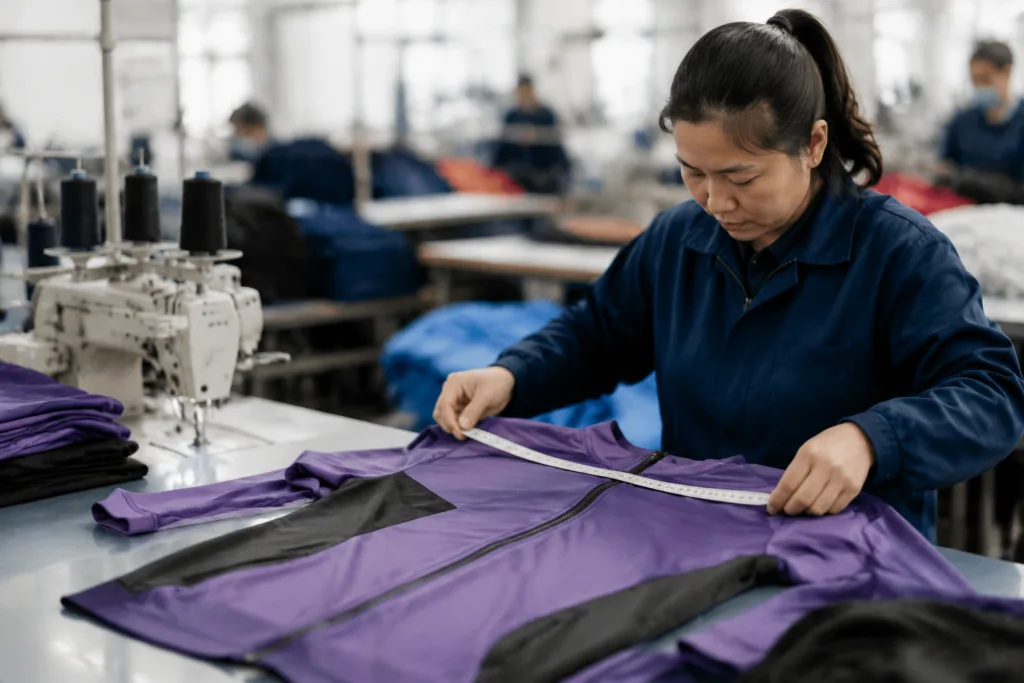
Domestic manufacturing may support shorter replenishment cycles and easier communication during demand changes. Overseas manufacturing may provide deeper material networks, specialized equipment, and attractive economics for planned volume, but international logistics can make small urgent orders less practical.
Ask prospective manufacturers how they handle a late color change, a revised size ratio, a fabric shortage, or an unexpected sales increase. Their answer will show whether they manage exceptions systematically or simply quote an ideal production scenario.
We recommend that brands document a continuity plan covering approved substitute materials, reserved fabrics, backup trims, reorder quantities, inspection standards, and acceptable delivery windows. This is especially important for uniforms, seasonal sportswear, and core products expected to remain available throughout the year.
Quality Control and Consistency Across Locations
Location does not automatically determine quality. Quality depends on the clarity of the specification, the competence of the production team, the sample approval process, the inspection plan, and the discipline used to control materials and workmanship.
Before bulk production, inspect or approve the fabric for composition, GSM, color, hand feel, width, stretch, and shrinkage behavior where relevant. During production, check cutting accuracy, panel matching, seam quality, measurements, decoration placement, labels, and finishing. Before shipment, confirm quantity, packing, carton markings, and final appearance.
For garments sold into the United States, product safety requirements should be considered alongside commercial quality. The CPSC explains relevant clothing flammability requirements, showing why compliance and testing decisions should be built into product development rather than treated as a last-minute location issue.
To understand how sampling reduces risk before bulk production, focus on what the approved sample actually controls: fit, construction, fabric behavior, decoration, trim placement, and the visual standard for production. A sample is not merely a sales prototype; it is a reference point for manufacturing consistency.
When Domestic Manufacturing Is Usually a Strong Fit
Domestic manufacturing is often a sensible option when speed, frequent collaboration, and low logistical complexity matter more than the lowest factory quotation. It can suit brands that need close product development, quick market testing, or rapid replenishment.
- Small or uncertain initial demand
- Short launch windows or frequent product revisions
- Complex garments requiring close sample collaboration
- Products with high value per unit and lower price sensitivity
- Programs requiring frequent replenishment in small quantities
- Teams that prefer in-person factory visits and local coordination
Domestic does not always mean low MOQ, fast production, or easy quality control. Confirm those assumptions with the specific factory and product category. A local supplier with limited capacity may be less flexible than an experienced overseas manufacturer with a mature development process.
When Overseas Manufacturing Is Usually a Strong Fit
Overseas manufacturing is often a good fit when the product is repeatable, demand is reasonably predictable, and the brand needs competitive economics or specialized production capability. It can work particularly well for larger programs, standard fabrications, and products supported by clear technical documentation.
- Planned volume that supports international freight efficiently
- Basic or repeatable garments with stable specifications
- Products requiring specialized fabrics, equipment, or decoration
- Brands able to plan several months ahead
- Teams with experience managing documentation and logistics
- Programs where lower landed cost supports the commercial model
Overseas sourcing should not be selected solely because a supplier offers the lowest unit price. Confirm total landed cost, production capacity, communication practices, material availability, inspection procedures, and the supplier’s record of meeting agreed specifications.
How Brand Stage Affects the Choice
A startup usually benefits from reducing irreversible commitments. That may mean a smaller order, a standard fabric, a limited color range, or a manufacturer willing to support practical sampling and low-volume production. The objective is to validate the product without tying up too much cash in inventory.
A growing brand can compare both models using actual sales data. At this stage, repeatability, reorder timing, material continuity, and a clear cost structure become more important. The brand may use one supplier for core volume and another for development or rapid replenishment.
A mature brand may prioritize capacity, multi-season consistency, compliance systems, forecasting, and contingency planning. It can justify more extensive supplier qualification because a production interruption affects a larger customer base and revenue stream.
| Brand stage | Primary concern | Useful evaluation approach |
|---|---|---|
| Startup | Cash exposure and product validation | Compare MOQ, sample cost, communication, and flexibility |
| Growth | Repeatability and profitable replenishment | Compare landed cost, capacity, material continuity, and reorder speed |
| Mature | Scale, resilience, and compliance | Audit systems, forecast capacity, quality controls, and contingency plans |
Questions to Ask Before Selecting a Manufacturer
A structured supplier conversation reveals more than a price sheet. Ask questions that force the manufacturer to explain assumptions and define responsibilities.
- What products and construction types does the factory produce regularly?
- What fabric compositions, GSM ranges, and finishing options are available?
- What is the MOQ for stock fabric, custom color, and custom trim?
- How many sample revisions are normally needed for this product?
- Which approvals are required before bulk cutting begins?
- How are measurement tolerances and workmanship standards documented?
- What quality checks happen before, during, and after production?
- How are urgent changes, shortages, or defects escalated?
- What costs are excluded from the quotation?
- What production and shipping dates depend on buyer approval?
- Can the supplier support reorders with the same fabric and color?
Compare the quality of the answers, not just the answers themselves. A manufacturer that clearly explains material constraints, production dependencies, and inspection points may be a lower-risk partner even when its first quotation is not the lowest.
Common Mistakes in the Domestic Versus Overseas Decision
Comparing Only Factory Unit Prices
Ignoring freight, duties, finance, storage, inspection, and coordination can make an overseas quote appear artificially attractive. Always compare landed cost using the same quantity, delivery point, packaging standard, and quality expectation.
Assuming Nearby Means Easier
A domestic factory may be physically close but still have limited capacity, weak communication, or little experience with your garment category. Location reduces some barriers; it does not remove the need for supplier qualification.
Choosing Overseas Production Without Enough Planning
International production becomes difficult when a brand approves samples late, changes artwork after materials are ordered, or has no plan for customs and receiving. Build extra decision gates into the schedule and assign ownership for every approval.
Underestimating Product Complexity
A garment with unusual seams, performance fabric, multiple decoration methods, or detailed grading needs more development control. Select based on technical capability and proven process discipline rather than assuming all factories can transfer the same design successfully.
Changing Suppliers Without Diagnosing the Problem
If the issue is an unclear tech pack, unstable forecast, or late approval, moving factories may not solve it. Before making a change, evaluate when it makes sense to switch manufacturing partners and separate supplier capability problems from internal process problems.
A Practical Decision Checklist
Use the following checklist before making a final decision. Score each manufacturer against the same requirements and record assumptions in writing.
- Cost: Have you calculated landed cost rather than factory price only?
- MOQ: Does the minimum order match your cash position and demand confidence?
- Communication: Can the supplier interpret your tech pack and respond within your working rhythm?
- Complexity: Does the factory have relevant experience with your fabric, construction, and decoration?
- Lead time: Are sampling, approvals, production, freight, customs, and receiving included?
- Flexibility: Can the supplier handle a changed size ratio, revised forecast, or reorder?
- Quality: Is there an approved sample and a documented inspection process?
- Compliance: Are labeling, care instructions, safety, testing, and destination-market requirements clear?
- Continuity: Can the same fabric, trims, color, and fit be reproduced later?
Domestic vs overseas clothing manufacturers should be compared using the same commercial assumptions. If one quote is based on delivered goods and another is based on ex-factory pricing, the comparison is not ready. Normalize the data first, then consider softer factors such as response speed, transparency, and confidence in issue resolution.
Key takeaway: The right manufacturing route is the one that gives your brand an acceptable balance of cost, control, speed, flexibility, and quality at its current stage.
Conclusion: Choose the Model That Supports Your Product Goals
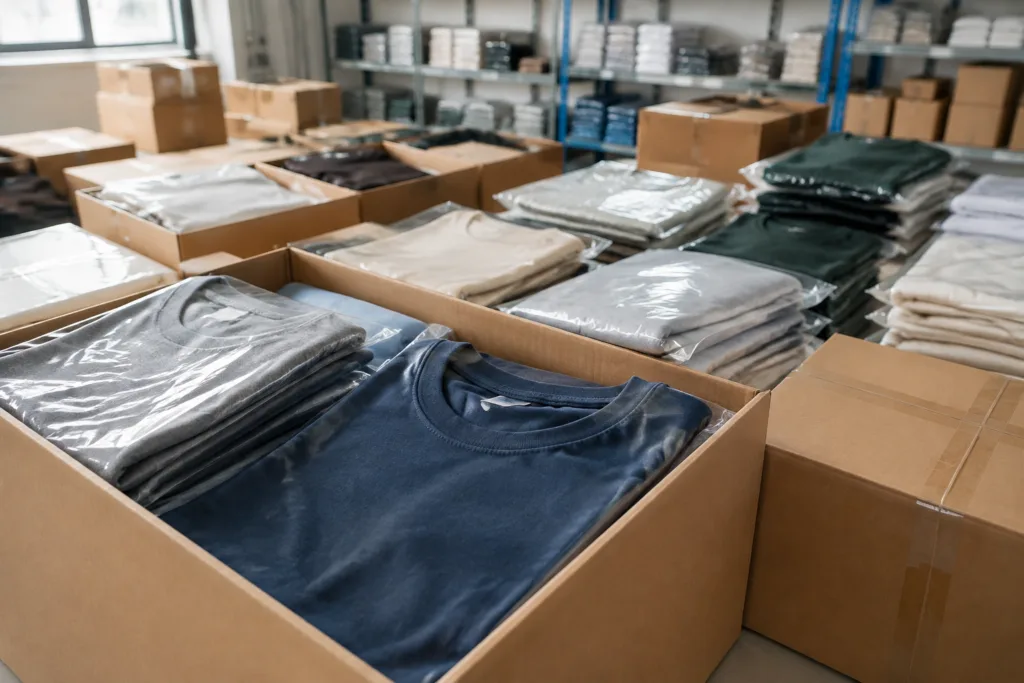
Domestic and overseas clothing manufacturers can both support successful apparel programs. Domestic production may reduce communication and replenishment friction, while overseas production may provide attractive landed economics, specialized capability, or broader sourcing options. Neither model is automatically safer or more profitable.
Start with the product, order size, delivery requirement, and business risk you can realistically manage. Then compare suppliers using total cost, MOQ, sample process, technical capability, quality controls, compliance preparation, and supply-chain flexibility. A thoughtful manufacturer can also help you identify which assumptions need testing before you commit to bulk production.
For a practical consultation or quotation, prepare your garment type, target quantity, fabric preference, size range, logo or decoration requirements, packaging expectations, delivery location, and timeline. Those details allow a manufacturer to assess the project realistically and recommend a production path based on facts rather than general claims.
Frequently Asked Questions
Are domestic clothing manufacturers always more expensive than overseas manufacturers?
No. Domestic factories may have higher quoted production costs, but overseas sourcing can add freight, duties, insurance, customs, storage, and coordination expenses. Compare total landed cost for the same product, order quantity, delivery destination, and quality requirements before deciding.
Is overseas manufacturing suitable for a small clothing startup?
Yes, if the manufacturer offers a realistic MOQ, the product is clearly specified, and the startup can plan far enough ahead. Smaller brands should also consider cash exposure, sample revisions, freight economics, and the risk of holding more inventory than demand supports.
Which option provides faster apparel production?
Domestic manufacturing often provides shorter physical delivery and easier urgent communication, but actual speed depends on capacity, material availability, approvals, and production scheduling. Overseas production can be efficient when materials and specifications are ready, but international freight and customs add calendar time.
How can I control quality with an overseas clothing manufacturer?
Use a detailed tech pack, approve a representative pre-production sample, define measurement tolerances, confirm fabric and color standards, and schedule inspections during and after production. Written specifications and clear approval records are more important than location alone.
Does a lower MOQ mean a better manufacturer for my brand?
Not necessarily. A low MOQ can reduce inventory risk, but it may come with a higher unit cost, limited fabric choices, or less efficient production. Evaluate MOQ together with fabric availability, sample quality, communication, repeatability, and the total cost of the order.
Should I use one manufacturer for all products?
Not always. A supplier that is excellent for basic T-shirts may not be the right fit for technical outerwear or complex uniforms. Match each product family to the manufacturer’s relevant capabilities, while maintaining consistent documentation and quality standards across the supply base.