







Polo shirt quality control is not a single inspection at the end of production. It is a sequence of checks that starts with fabric and trims, continues through cutting and sewing, and finishes with packing verification before shipment. For buyers, understanding this process is one of the best ways to judge whether a supplier can deliver consistent bulk quality rather than just a good-looking sample.
If you are comparing factories or preparing a branded order, it helps to review polo shirt manufacturing options with quality control in mind, not only price and lead time. In our manufacturing work, that means checking fabric behavior, confirming logo methods, reviewing size tolerances, planning in-line inspections, and aligning packaging details before bulk production starts so problems are caught early instead of after shipment.
Why quality control matters in custom polo shirt manufacturing
Quality control matters because polo shirts combine several variables that can drift during production. Fabric weight, collar shape, placket construction, color consistency, embroidery position, and size tolerance all affect how the final garment is perceived.
A buyer may receive garments that technically match the purchase order quantity but still create business problems if fit is inconsistent, logos look uneven, or colors vary between lots. That is why a professional QC system focuses on reliability, not only defect sorting.
Key takeaway: Good QC is a production control system, not just a final inspection table.
What buyers should expect from a professional polo shirt QC process
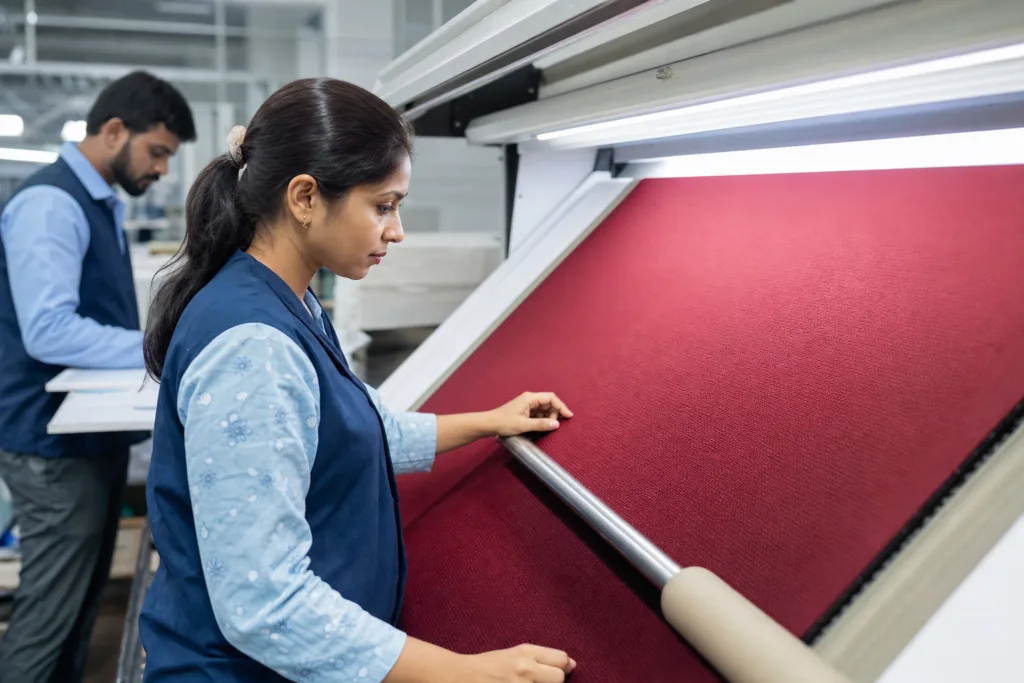
A professional process should be documented, staged, and measurable. Buyers should expect checks before production, during production, and after production, with clear acceptance criteria for fabric, workmanship, measurements, appearance, and packing.
From our manufacturing perspective, the most useful QC system has three practical goals:
- prevent defects before they multiply in bulk
- detect deviations early enough to correct them
- create records that support accountability if questions arise later
Well-structured apparel quality control procedures also help buyers compare suppliers more fairly. A factory that can explain its checkpoints in detail usually has stronger process discipline than one that only promises a final inspection.
Step 1: Fabric incoming inspection and raw material verification
The first real QC gate is incoming material inspection. Before cutting starts, the factory should confirm that the bulk fabric and trims match the approved specification, not simply the supplier invoice.
For custom polo shirts, this usually includes checking:
- fabric composition against the approved order
- GSM or fabric weight consistency
- color against approved lab dip or reference standard
- fabric width and usable width
- knit defects such as yarn contamination, holes, barre, slubs, or streaks
- collar and cuff rib quality, recovery, and shade matching
- button, thread, label, and packaging trim accuracy
Polo fabrics like pique cotton, cotton polyester blends, performance knits, and stretch blends behave differently in production. A small variation in GSM or elasticity can change the fit, drape, and collar balance of the finished garment.
At Ninghow, we treat incoming inspection as the stage where many future problems can be prevented at low cost. If the fabric lot is unstable or the rib color is off, it is far easier to stop before cutting than to repair hundreds of finished garments.
Step 2: Color matching, shrinkage checks, and fabric performance testing
Before bulk sewing begins, the factory should verify how the fabric behaves under realistic conditions. For polo shirts, the most important practical checks are color matching, shrinkage, twisting risk, surface appearance, and basic performance consistency.
Color is especially important when the order includes matching body fabric, collar rib, cuff rib, placket parts, or multi-panel styling. Even when all components are technically the same color code, dye lot differences can create visible mismatch under store or daylight conditions.
| QC item | What is checked | Why it matters for polo shirts |
|---|---|---|
| Color matching | Body, collar, cuff, placket, thread, logo shade | Visible mismatch makes the garment look inconsistent |
| Shrinkage | Lengthwise and widthwise change after washing | Affects final measurements and fit stability |
| Fabric skew or torque | Twisting after wash or relaxation | Can distort side seams and placket alignment |
| Surface quality | Pilling tendency, streaks, knitting defects | Impacts appearance and wear perception |
| Stretch and recovery | Elastic response of knit areas | Affects comfort and collar or cuff performance |
Buyers should ask whether shrinkage results are considered before setting the production measurement spec. A common mistake is approving a size chart without accounting for wash or finishing behavior, which later causes preventable tolerance failures.
Step 3: Cutting room control, pattern accuracy, and panel consistency
Once materials are approved, cutting room control becomes the next major risk point. If panels are cut inaccurately, no amount of careful sewing can fully restore shape and size consistency.
In custom polo shirt production, cutting room QC usually checks marker accuracy, fabric relaxation, grain alignment, panel symmetry, and notch precision. This is particularly important for striped fabrics, contrast plackets, tipped collars, and styles with side panels.
The goal is simple: every bundle moving to sewing should represent the approved pattern and size spec. If left and right panels are not balanced, or if collar pieces are cut with tension distortion, the finished shirts will show twisting, uneven hems, or misaligned plackets.
Buyers who want a clearer understanding of this stage can review the polo shirt manufacturing process from fabric selection to bulk production because many quality outcomes are determined before stitching starts.
Step 4: In-line sewing inspection for stitch quality, seam strength, and construction consistency
In-line sewing inspection is where a professional factory prevents bulk defects from spreading. Instead of waiting until the order is finished, inspectors or line leaders check output during production to confirm that construction stays within standard.
For polo shirts, key sewing checkpoints often include collar attachment, placket shape, shoulder joining, sleeve setting, side seam balance, hem finishing, buttonhole quality, and button attachment security. Stitch density, thread tension, seam smoothness, skipped stitches, raw edge control, and puckering are all practical inspection points.
Seam performance is not only about appearance. It also relates to durability, wearer comfort, and wash behavior. In technical discussions about seam engineering, references such as seam strength and stitch quality checks help explain why thread choice, stitch construction, and seam setup matter when evaluating garment reliability.
From our manufacturing perspective, in-line QC should focus on trend detection as much as individual defects. If one operator starts producing plackets that drift off center, early intervention prevents the same issue across dozens of cartons.
| Sewing checkpoint | Common defect | Prevention method |
|---|---|---|
| Collar attachment | Wavy neckline or uneven collar spread | Control feed tension and match collar length accurately |
| Placket construction | Off-center placket or uneven topstitch | Use guides and first-piece approval |
| Side seams | Twisting or unmatched panels | Verify panel pairing and sewing alignment |
| Hem finishing | Ropy hem or puckering | Adjust machine settings for knit stability |
| Button area | Loose buttons or poor buttonholes | Check attachment tension and cutting cleanliness |
Step 5: Logo application checks for embroidery, screen printing, heat transfer, or sublimation
Logo quality can decide whether a custom polo shirt looks premium or inconsistent. Even if the garment itself is well made, a poorly executed logo will quickly undermine the whole order.
The correct QC method depends on the decoration type:
- Embroidery: check position, thread color, stitch density, backing cleanliness, edge sharpness, and fabric puckering
- Screen printing: check color accuracy, opacity, registration, hand feel, and print adhesion
- Heat transfer: check placement, bonding, edge lift risk, and wash stability
- Sublimation: check color clarity, migration, and panel matching where applicable
Logo inspection should happen on approved strike-offs or pre-production samples first, then again during bulk output. A buyer should never assume that a logo which looked good on one sample will automatically remain consistent at scale.
Key takeaway: Decoration QC is not separate from garment QC. It must be integrated with fabric behavior, positioning control, and finishing standards.
Step 6: Measurement control and size tolerance checks during production
Measurement control should happen during production, not only after garments are completed. This is especially important for custom polos because knit fabrics can relax or shift through sewing, pressing, and finishing.
Factories usually measure semi-finished and finished pieces against the approved spec sheet. The most critical points often include chest width, body length, shoulder width, sleeve length, cuff opening, collar height, placket length, and bottom sweep.
A practical measurement program normally includes:
- approved size chart with tolerance
- clear measuring method for each point
- first-piece measurement approval
- in-line size audits across different operators and bundles
- final random measurement verification before packing
When buyers ask for tighter tolerances, the request should be realistic for the fabric type and construction. Very tight tolerance expectations on stretch knits or washed fabrics can create conflict unless both sides agree on measurement conditions in advance.
We often advise buyers to compare inspection points with a polo shirt quality checklist for bulk buyers so there is no confusion between sample appearance and bulk measurement control.
Step 7: Ironing, finishing, and appearance inspection
Finishing is where visual consistency is protected before garments move to final inspection. A polo shirt can pass sewing checks and still look poor if pressing, thread trimming, stain control, or placket shaping is inconsistent.
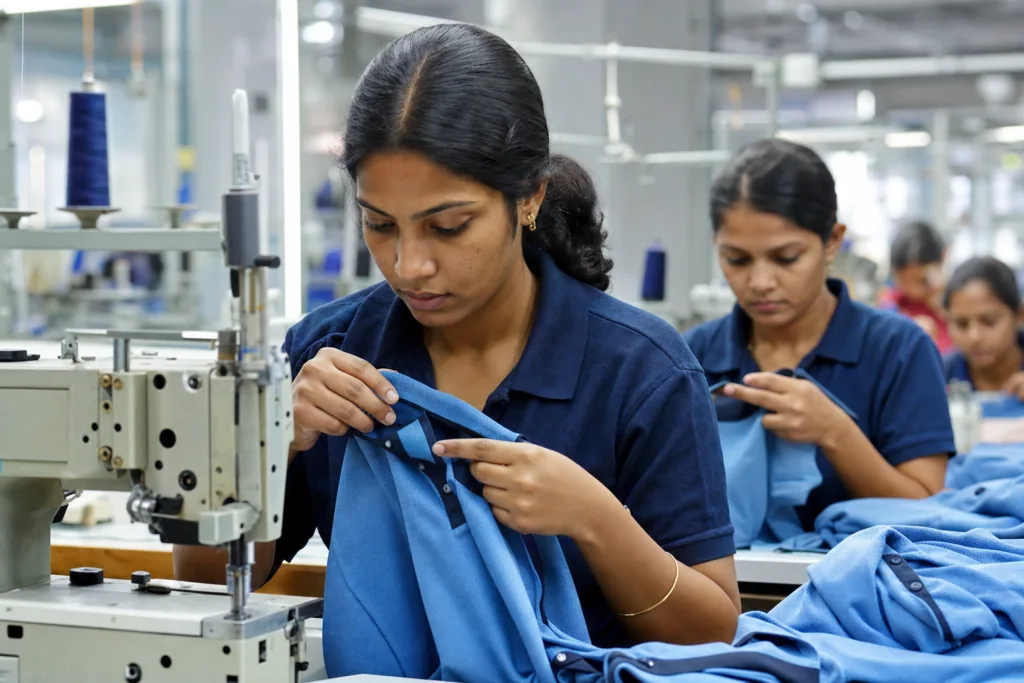
Appearance inspection usually focuses on:
- clean surface without oil marks, stains, or dirt
- flat and balanced collar shape
- straight placket presentation
- neat thread trimming
- symmetrical sleeve and side seam appearance
- proper pressing without shine or heat damage
This stage also matters for retail presentation and uniform programs. If garments are packed with poor pressing quality or unstable folding, the first impression at delivery can be weaker even when construction is acceptable.
Step 8: Final garment inspection before packing
Final inspection is the last comprehensive product check before packing approval. It usually combines workmanship, measurement, appearance, and assortment verification using a defined sampling method or order standard agreed by buyer and supplier.
At this point, inspectors typically review random units from completed lots and check whether the garments match the approved reference sample and order specification. They also confirm whether earlier process controls were effective or whether hidden consistency issues remain.
What a strong final inspection should cover:
- overall workmanship and construction
- measurement compliance within tolerance
- logo position and finish quality
- color consistency across inspected units
- fabric defects missed earlier in production
- style details such as placket, buttons, collar, cuffs, vents, and hems
- cleanliness and pressing standard
If a supplier only talks about final inspection and cannot explain earlier checkpoints, buyers should be cautious. Strong final inspection is useful, but late-stage detection is always more expensive than process prevention.
Step 9: Packaging, labeling, and carton verification for bulk shipping
Packaging QC is often underestimated, yet it directly affects receiving accuracy and retail readiness. Errors at this stage can create shipment disputes even when the garments themselves are good.
For custom polo orders, packaging verification often includes size sticker accuracy, care label placement, main label correctness, barcode or hangtag matching, folding method, polybag specification, ratio pack accuracy, carton count, carton marking, and shipping mark confirmation.
Buyers with private label requirements should make sure all packaging components are approved before bulk packing starts. This includes logo labels, woven labels, wash care labels, hangtags, spare buttons if required, and any retailer-specific carton instructions.
When orders move through multiple SKUs and destinations, the packing stage becomes a control point for logistics accuracy as much as garment quality.
Common polo shirt defects found during QC and how they are prevented
The most frequent defects are usually not dramatic failures. They are small inconsistencies repeated across volume. That is why prevention systems matter more than isolated rework.
| Defect | Likely cause | Prevention focus |
|---|---|---|
| Collar waving | Poor tension or mismatched collar length | Collar feed control and in-line checks |
| Placket twisting | Panel distortion or inaccurate sewing | Cutting accuracy and first-piece approval |
| Logo puckering | Incorrect embroidery density or unstable fabric | Test settings on actual bulk fabric |
| Measurement out of tolerance | Shrinkage not accounted for or inconsistent sewing | Pre-test fabric behavior and in-line measurement |
| Shade variation | Mixed dye lots or trim mismatch | Lot segregation and color verification |
| Loose buttons | Weak attachment setting | Button pull checks and machine calibration |
Many of these issues are discussed practically in our guide to common polo shirt production problems and prevention, because defect prevention is easier when buyers understand where process risk usually begins.
Polo shirt inspection standards: what buyers should ask suppliers to define
Buyers should ask suppliers to define the inspection basis before production starts. Do not leave quality expectations at the level of “good quality” or “export standard.” Those phrases are too vague to manage risk.
Instead, confirm the following points in writing:
- approved sample reference and revision status
- fabric composition and GSM tolerance
- color standard or lab dip reference
- measurement chart with tolerance by size
- workmanship standard for visible defects
- logo placement method and acceptable variation
- packing method and assortment standard
- inspection timing, sampling basis, and defect classification
A practical supplier conversation should also cover what counts as critical, major, and minor defects. That shared language improves decision-making if issues appear during bulk production.
How Ninghow manages bulk apparel quality checks across the full production flow
At Ninghow, we view quality control as a chain of linked decisions rather than a final gate. That starts with understanding the intended use of the polo shirt, because a corporate uniform order, golf polo, school program, and promotional event shirt may not require the same fabric behavior, finishing level, or packaging setup.
Our process normally connects sample approval, material review, in-line production control, measurement tracking, decoration verification, finishing inspection, and packing checks. The purpose is not to create unnecessary complexity. It is to reduce avoidable variability between approved sample and shipped bulk goods.
For buyers, the practical value is clarity. If a project involves private label development, embroidery placement, custom packaging, or mixed-size distribution, those requirements should be built into the QC plan before production begins.
How buyers can reduce quality risk before placing a bulk order
The most effective way to reduce quality risk is to make fewer assumptions. Many production disputes happen because the supplier and buyer use different definitions of acceptable quality.
Before confirming a bulk order, buyers should prepare:
- a clear tech pack or product specification
- approved artwork files and logo size details
- fabric and color expectations
- measurement chart with tolerances
- label, hangtag, and packaging requirements
- target use scenario, such as uniform, retail, golf, or promotional wear
- sample comments closed before bulk launch
A low price cannot compensate for unclear specifications. In our experience, the fastest way to reduce QC disputes is to tighten communication before production, not after defects appear.
QC documents and records that support accountability in custom apparel production
Reliable quality control should leave a paper trail or digital record. Buyers do not need every internal factory form, but they should expect enough documentation to confirm that critical steps were performed.
Useful QC records may include incoming material reports, shrinkage test notes, in-line inspection records, measurement reports, defect correction logs, final inspection summaries, and packing verification sheets. These records become especially valuable when repeat orders need the same standard across seasons or replenishment runs.
Key takeaway: Documentation does not replace good production management, but it makes quality expectations traceable and repeatable.
Final buyer checklist for evaluating a polo shirt manufacturer
When evaluating a supplier, buyers should focus on whether the factory can explain its control logic clearly and consistently. A dependable QC process is usually visible in the questions the supplier asks before production even starts.
- Can the supplier explain fabric inspection and shrinkage control?
- Do they define measurement methods and tolerance clearly?
- Is there in-line sewing inspection instead of only final inspection?
- Can they explain how logo quality is checked by decoration method?
- Do they control labels, packing ratios, and carton marks carefully?
- Can they provide consistent records for sample and bulk approval stages?
- Do they understand the end use of the polo shirt and adjust standards accordingly?
A manufacturer that answers these points clearly is usually easier to work with over the long term than one that relies on general promises.
Conclusion
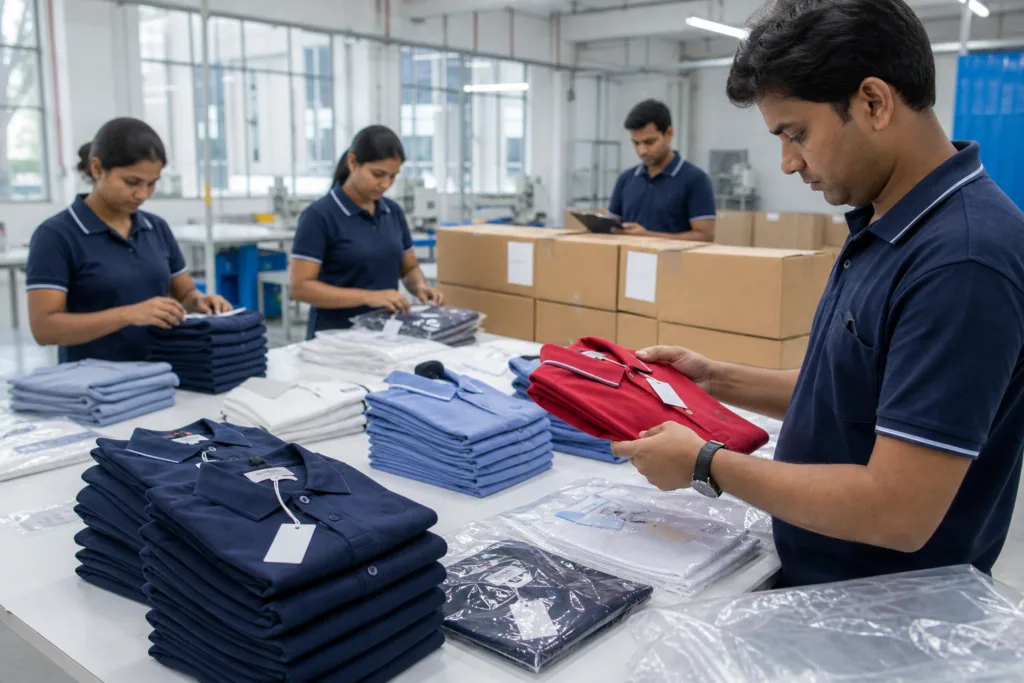
Polo shirt quality control works best when it is built into the full production flow, from raw material verification to carton inspection. For buyers, the main lesson is that bulk reliability comes from process discipline: stable fabric input, controlled cutting, in-line sewing checks, logo verification, measurement control, careful finishing, and accurate packing.
If you are sourcing custom polos, ask suppliers to explain their checkpoints in practical terms and compare those answers against your own product requirements. A strong polo shirt quality control system is not complicated for the sake of it. It is simply a structured way to protect consistency, reduce rework, and make bulk production more predictable.
Frequently Asked Questions
What is the most important stage in polo shirt quality control?
The most important stage is early process control, especially fabric approval and in-line production inspection. Final inspection matters, but many expensive defects begin with fabric instability, poor shrinkage planning, or repeated sewing errors that could have been corrected much earlier.
How do buyers check whether a supplier has a real QC system?
Buyers should ask the supplier to explain each checkpoint from incoming fabric to packing, including measurement methods, defect standards, and records kept during production. A real QC system is specific, staged, and documented rather than described only as “we inspect before shipment.”
Why do polo shirt measurements sometimes fail in bulk production?
Measurements usually fail because shrinkage, fabric relaxation, or sewing variation was not controlled correctly before and during production. This is why approved size specs must be linked to actual fabric behavior, clear measuring methods, and ongoing in-line measurement checks.
What defects are most common in custom polo shirt orders?
The most common defects include collar waving, placket twisting, logo puckering, shade variation, loose buttons, and measurements outside tolerance. These problems are usually prevented through better fabric control, first-piece approval, in-line inspection, and decoration testing on actual bulk materials.
Should logo inspection be handled separately from garment inspection?
Logo inspection should be part of the overall garment QC plan, not treated as a completely separate issue. Embroidery, printing, transfer, or sublimation quality depends on fabric stability, positioning accuracy, and finishing consistency, so decoration checks need to connect directly with garment production control.
What QC documents should buyers request for custom polo shirt orders?
Buyers should request practical records such as material approval results, shrinkage or color check notes, in-line inspection findings, measurement reports, final inspection summaries, and packing verification data when needed. These documents help confirm that the supplier followed the agreed quality process and make repeat orders easier to manage consistently.