
Understanding MOQ in Apparel Manufacturing
MOQ, or Minimum Order Quantity, is one of the most crucial terms you’ll encounter when launching or scaling an apparel brand. MOQ sets the baseline order size a factory will accept, shaping your costs, risks, and product assortment. In today’s global garment market, mastering the art of apparel MOQ negotiation can drastically lower startup barriers, help manage cash flow, and open doors to new product innovations. Let’s break down how MOQs are formed, why they’re set, and how brands can creatively work with these limits.
What Is MOQ? The Basics for Apparel Brands

For apparel, MOQ is typically the smallest number of units that a supplier or factory agrees to produce for a single style, fabric, or color. This covers not just total item quantity, but often sub-MOQs for each variant—size, color, and sometimes even embellishment. Factories establish MOQs to balance their operating costs, machinery setup, and bulk purchasing of raw materials. You might see MOQs set as “300 pieces per color,” or “500 pieces per style (assorted sizes).” Knowing how these numbers are calculated is step one in effective negotiation.
Why Factories Set MOQs: Cost Structure Breakdown
The logic behind MOQs stems from a factory’s need to optimize production runs. Key factors include:
- Yarn, fabric, and trim sourcing: Suppliers have their own MOQs for raw materials.
- Machinery setup: Changing patterns or colors means downtime and extra labor.
- Efficiency targets: Larger orders yield better yield per hour, reducing waste.
- Inventory risk: Factories want to avoid leftover materials.
Ninghow, as a manufacturer, often explains to clients that even a small MOQ, say 100 hoodies, may mean buying enough fabric for 300 due to supplier requirements. Factories build MOQs to cushion such minimums.
Breaking Down MOQ Components
MOQs can look simple on paper but are actually made up of several parts:
| MOQ Type | What It Covers |
|---|---|
| Style/Design | The main pattern (e.g., a basic hoodie) |
| Fabric | Material type, weight, and composition |
| Color | Each dye lot or color run |
| Size | Size breakdown (XS–XL) |
| Decoration | Prints, embroidery, or labels |
Understanding every layer helps you ask the right questions and combine MOQs in smarter ways.
How Combining MOQ Variants Can Save You Money
One of the most powerful tools in apparel MOQ negotiation is combining variants. Instead of treating every color or size as a separate order, ask your factory if you can “merge” counts:
- Color grouping: If you order 100 each of three colors, can you hit a 300 MOQ per style?
- Fabric pooling: Using a single base fabric for multiple styles may meet fabric supplier MOQ.
- Size blending: Approving flexible size breakdowns to keep overall MOQ realistic.
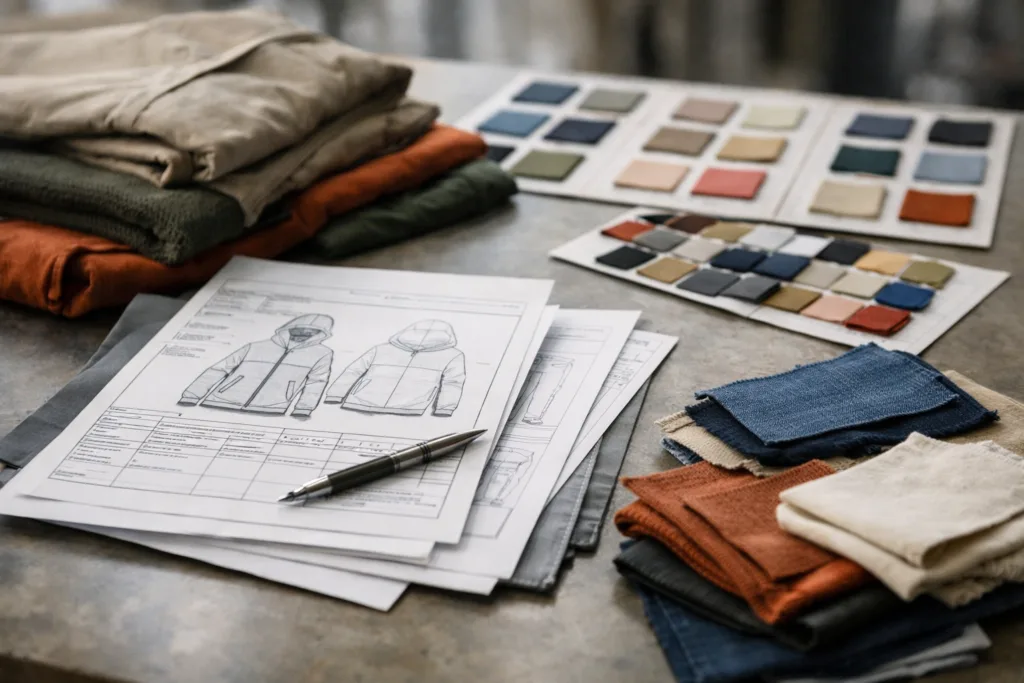
Some factories allow mix-and-match orders as long as the total hits their efficiency target. Creating a clear tech pack helps communicate these needs.
MOQ Calculation: A Real-World Example
Suppose you want 5 sizes, 3 colors, and two prints for one hoodie style. The factory’s MOQ is “300 pieces per style,” but the fabric mill needs 150 yards per color, and decoration supplier requires 100 pieces per print. Smart negotiation means:
- Working with the factory to combine sizes and colors into the overall style MOQ.
- Choosing prints that can be grouped into the same production run.
- Opting for fabrics that are standard inventory to ease material MOQ.
This approach isn’t just theoretical—it’s how small brands routinely get factories to work with modest launch orders. Factories like Ninghow may suggest practical breakdowns to bridge gaps in material and decoration MOQs.
Trial Orders: Reducing Risk and Unlocking Lower MOQs
Many factories offer “trial” or “sample” orders at a lower MOQ, especially for first-time clients. These trial runs let brands test a supplier’s quality and timeline without heavy investment. Here’s how to approach a trial order negotiation:
- Be upfront about your business size and launch plans.
- Highlight your potential for scale—factories like long-term customers.
- Offer to pay a small surcharge for setup/loss on mini runs.
- Ask for a flexible mix of sizes/colors if hitting the full MOQ isn’t possible.
When requesting a trial order, a clear and respectful RFQ template streamlines the process and shows professionalism.
Effective Negotiation Scripts for Apparel MOQ
Setting the Stage
Begin any negotiation by showing you have researched the factory’s capabilities. Express understanding of their business needs. For example:
- “We’re aware your standard MOQ is 500 per style, but our current launch plan requires 300 units. Can we explore blending colors or sizes to reach this MOQ?”
Addressing Material Limits
- “If we choose your stock fabrics, is it possible to reduce the MOQ or combine orders with other clients?”
Trial Order Pitch
- “We’re a new brand but hope for long-term collaboration. Can we arrange a small run for our first collection, perhaps at a slightly higher price per unit to offset setup costs?”
Clarifying Size and Variant Breakdown
- “Can you accept 300 pieces per style, split evenly across our standard sizes and three colorways?”
Approaching with respect and clarity wins goodwill, and often, flexibility on factory MOQs.
MOQ Negotiation Strategies That Work
- Do your homework: Research standard MOQs for product types in your target region.
- Bring comparable quotes: If another supplier has lower MOQs, share that information tactfully.
- Offer batching: Propose orders that fit into the factory’s existing production schedule.
- Suggest rolling orders: Multiple mini-orders processed in sequence, allowing both parties to test the partnership.
- Compromise with pricing: Agree to a premium per unit for small runs.
Refer to this pre-purchase checklist for more negotiation tips.
Common Mistakes When Negotiating MOQs
- Not understanding the real reason behind the factory’s MOQ (material, labor, or logistics).
- Pushing for unworkable low MOQs without offering any compromise.
- Ignoring the effects on unit price, timeline, or quality for small runs.
- Failing to detail your size and color breakdowns upfront.
How MOQ Impacts Pricing, Lead Time, and Quality
Lower MOQs often come with caveats:
- Pricing: Per-unit cost may rise for small orders due to less efficient setup.
- Lead time: Factories prioritize larger batches; small runs might be batched between big jobs.
- Quality control: The same QC processes apply, but with less margin for system adjustments.
Discuss these trade-offs openly and work with suppliers to set realistic expectations.
Sample Development vs Production MOQ
Don’t confuse MOQ for full production orders with sample development. Factories often produce a handful of samples for fit, construction, and pattern approval. These do not count toward standard production MOQs and may have their own separate costs and lead times.
Fabric and Trim Supply: The Hidden MOQ Layer
Most brands focus only on finished goods MOQs, but fabric and trims carry their own minimums. If your chosen zipper, thread color, or special trim requires a large bulk purchase, you may need to reconsider design or source from a factory with existing stock. Streamlining trims and colors can substantially lower your effective MOQ.
Negotiating Decoration MOQ: Print, Embroidery, and More
Print and embroidery suppliers often set their own MOQs per design or color. An easy workaround is to select standard techniques or shared print placements. See more in the embroidery and MOQ guide.
Seasonal and Special Release MOQs
If you’re launching seasonal drops or limited editions, communicate with suppliers far ahead. These runs may justify a one-time lower MOQ, especially if you accept longer lead times or agree to some excess raw materials. Transparency wins trust.
Realistic Expectations: Balancing Creativity and Efficiency
Brands sometimes envision highly diverse color and size ranges. While exciting, each new SKU creates new MOQ challenges. For the launch phase, streamline your offering, focus on key colors/fits, and scale up diversity as your volumes grow.
Improving Your Negotiation Position: What Factories Want
- Clear tech packs: Articulated specs shorten negotiation cycles.
- Prompt communication: Fast answers help factories plan their workflow.
- Market growth: Sharing your expansion plans hints at bigger future orders.
- Ownership: Willingness to share setup risk sets you apart from “test orders.”
Leveraging Supplier Relationships: Partnership Over Price
Smart brands view their suppliers as partners, not just vendors. Developing trust enables factories to stretch on MOQs, prioritize your orders, and sometimes offer access to shared stock. Recruiting a manufacturer like Ninghow early in design stages can unlock cost-saving tips on fit blocks, fabric, and trims.
MOQ Negotiation for Apparel Brands: Success Stories
Emerging brands have successfully launched with modest MOQs by using creative negotiation:
- Negotiating pooled color runs with other clients.
- Agreeing to combine sizes and prints for bulk production.
- Accepting slight changes in trims to use existing inventory.
- Sharing production slots with larger customers for priority access.
These win-win solutions showcase the power of understanding factory logic and offering creative flexibility.
MOQ Negotiation for Apparel Brands: Key Takeaways
Apparel MOQ negotiation is skill, art, and numbers game. Learn the components, ask clear questions, and provide options that fit both your brand and your supplier. Success means testing assumptions, tracking outcomes, and building solid supplier partnerships. Remember, both you and the factory benefit from growth and honest communication.
Frequently Asked Questions
Can I mix colors or sizes to meet MOQ?
Often yes. Many factories accept blending variants (colors, sizes) as long as the total quantity per style hits their efficiency minimum.
Why do small orders cost more per item?
Lower volume means setup costs are spread over fewer units, increasing fabric waste and operator labor for smaller runs.
Do factories ever allow below-MOQ orders?
Sometimes, especially for trial orders or loyal clients. You may need to accept a price premium or offer a larger future order.
How do I negotiate if I’m a new brand?
Be transparent, show growth potential, offer flexibility, and agree to realistic price compromises for small runs.
Are decoration MOQs different than product MOQs?
Yes. Prints, embroidery, and other embellishments often carry their own MOQs based on setup and supply constraints.
Is it better to use factory stock fabrics?
Definitely for lower MOQs. Factory stocks offer immediate availability and avoid bulk material purchase risks.
Related Reading
- Reduce Apparel Returns: QC Techniques That Actually Work
- Compliance Essentials: Materials, Labels, & Testing for Your Garment Line
- The True Cost When Garment Production Gets Delayed
- Inline QC vs. Final Inspection: Which Approach Is Right for Your Apparel Brand?
- Signs You’ve Outgrown Your Factory: When to Switch Manufacturers
