



Most clothing made for international trade comes from Asia. China is the clearest single-country center in apparel-export data, while Bangladesh and Vietnam are also major export manufacturing hubs. India, Turkey, Pakistan, Cambodia, Indonesia, and countries within the European Union contribute important volumes or specialized categories.
That answer needs one qualification: there is no universal live count of every shirt, dress, or pair of trousers produced worldwide. Country comparisons normally use the value of exported apparel, which captures internationally traded production but not every garment made for domestic consumption.
Where Most Clothes Are Made—and What “Most” Means
The answer depends on whether “most” refers to export value, garment quantity, factory employment, or total output. Those measures can produce different rankings, so a responsible country claim should always state its metric, reporting year, and product coverage.
The Short Answer: Production Is Concentrated in Asia
Asia contains the largest concentration of export-oriented clothing manufacturing. China combines large-scale garment capacity with extensive textile and component supply networks. Bangladesh is strongly associated with high-volume export apparel, while Vietnam has become a significant center for a broad range of sewn products.
This concentration does not mean all clothing comes from those 3 countries. India and Pakistan connect garment production with substantial textile sectors; Cambodia and Indonesia are established apparel exporters; and Turkey serves important markets through both manufacturing capability and geographic proximity. Production also continues in Europe, the Americas, Africa, and other parts of Asia, particularly where speed, specialization, trade access, or local-market supply matters.
Why Apparel Exports Are the Usual Measure
Export statistics are widely used because customs authorities record goods crossing borders and assign them monetary values and product classifications. This creates a more comparable international measure than estimates assembled from factory counts or individual brand disclosures.
Export value is especially useful when the question concerns clothing supplied to overseas markets. However, it measures the declared value of traded goods, not a literal number of garments. A country exporting higher-priced coats could record more value than a country shipping a larger quantity of inexpensive T-shirts. Exchange rates and price changes can also move export values even when physical output changes less dramatically.
What Export Rankings Leave Out
Export data can understate countries with large domestic clothing markets because garments sold within the country never enter export records. It may also include re-exports or regional trade flows that need careful interpretation. A ranking can therefore describe international trade leadership without measuring every item manufactured.
It also does not show the complete route behind a garment. Cotton may be grown in one country, spun and knitted in another, dyed elsewhere, and finally cut and sewn in the country printed on the origin label. Country export totals identify where finished goods enter trade, but they do not automatically trace every upstream material and process.
How to Compare Clothing-Producing Countries
Before relying on a list of leading clothing producers, check 4 items: the metric, year, product category, and reporting entity. A table based on 2022 export value cannot be treated as interchangeable with a 2024 estimate of factory output or employment.
| Comparison metric | Reported unit | Question it can answer | Important limitation |
|---|---|---|---|
| Apparel export value | Currency per year | Which economies export the greatest value of covered clothing? | Does not count all domestic sales or physical garment units |
| Apparel export quantity | Pieces, weight, or another physical unit per year | Who ships the greatest recorded quantity in the covered categories? | Categories may use different units, and one piece can vary greatly in complexity |
| Manufacturing output | Currency or production index per period | How large is the measured domestic apparel industry? | National methods and industry boundaries may differ |
| Apparel employment | Workers or jobs | Where does the sector employ the most people? | Employment is not the same as output, productivity, or export value |
Compare the Same Product Category
A fair country comparison must use the same product definition on both sides. “Clothing” may refer only to knitted and woven apparel, or it may be used loosely for a wider group that includes footwear, leather goods, and accessories. Adding categories for one country but not another produces a misleading ranking.
Readers should look for the underlying customs chapters, industry classification, or dataset definition. If a source provides none, treat the result as a broad indication rather than a precise league table. The rule is simple: same category, same year, same unit, and the same treatment of imports and re-exports.
Separate Clothing from Textiles and Footwear
Textile production and clothing production are connected but not identical. Textiles include activities such as spinning yarn, weaving or knitting fabric, and producing some household or industrial materials. Clothing manufacturing generally refers to turning fabric and components into wearable garments.
A country can be a major textile producer without exporting finished apparel at the same scale. Another may import much of its fabric and specialize in cutting, sewing, finishing, and exporting garments. Footwear and accessories also follow different production systems, so their trade totals should not be added when the question is specifically where clothes are made.
Treat Countries and Trading Regions Consistently
Some reports list individual countries alongside a trading bloc or regional aggregate. That can create double counting if member-country figures are also shown, and it can hide substantial trade between members of the same region. A regional total is useful for showing geographic concentration, but it is not directly comparable with a single economy unless the methodology explains the treatment.
When evaluating a ranking, check whether it measures total exports, exports outside a trading bloc, or trade that includes exchanges between member countries. Use country-level figures for a country comparison and regional totals for a regional comparison rather than mixing the 2.
Why Production Clusters in Certain Countries
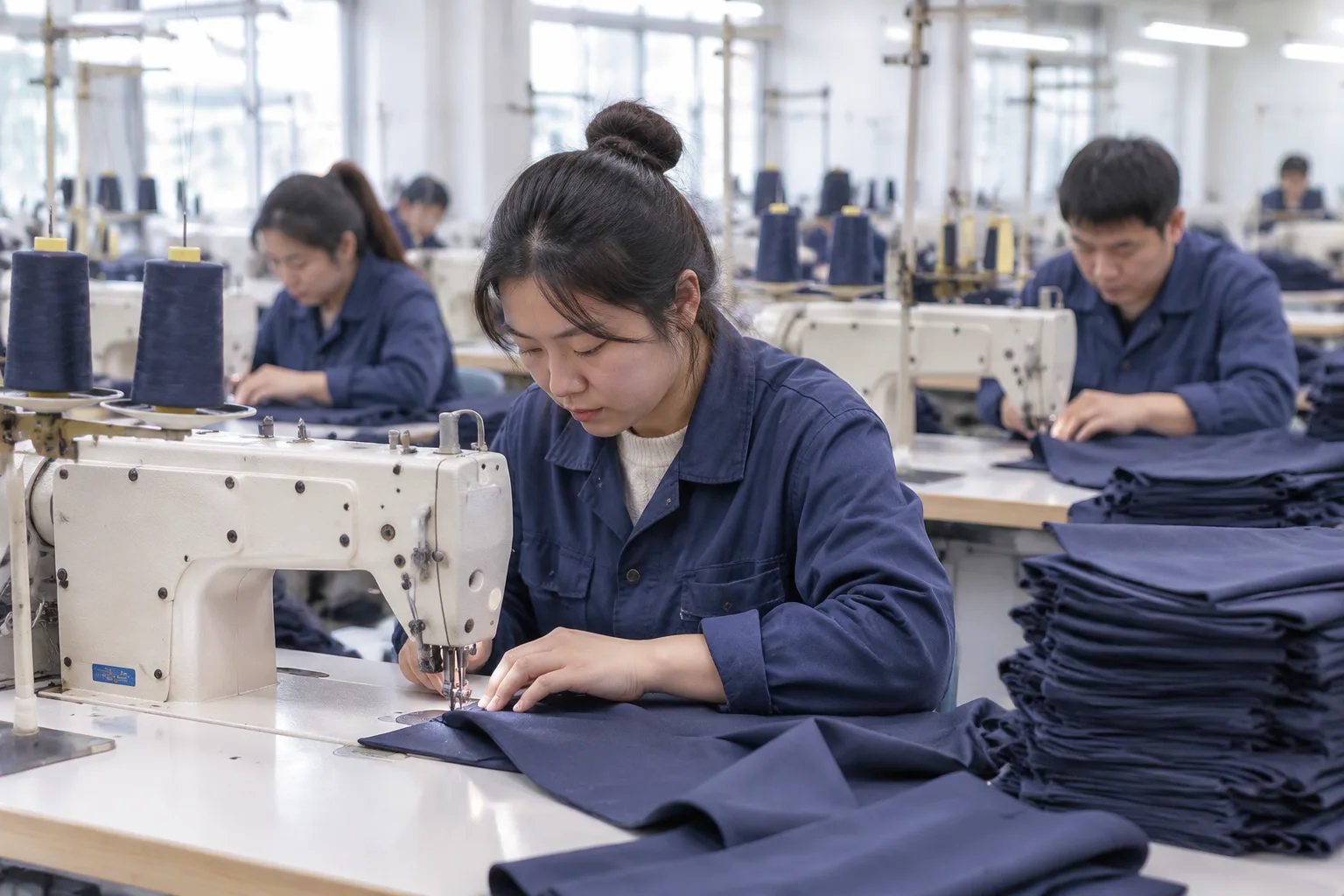
Clothing factories do not choose locations on wages alone. Reliable production depends on workers, technical management, materials, subcontractors, utilities, transport, finance, and access to buyers. When these elements develop in the same area, each participant can operate more efficiently than it could in isolation.
Skills and Product Specialization
Different garments require different knowledge. A basic knitted T-shirt, a tailored wool jacket, a waterproof seam-sealed shell, and an embellished dress involve different machinery, handling methods, quality risks, and production engineering. A country or manufacturing cluster may become competitive by repeatedly producing particular categories and building the relevant workforce around them.
Specialization matters when the product is technically demanding or the order must scale quickly. Buyers comparing locations should ask about experience with the specific fabric, construction, finishing process, and quality standard rather than relying on a country’s general reputation. National production strength does not prove that every factory in that country suits every garment.
Supplier Ecosystems and Material Access
A garment factory depends on more than its sewing lines. It may need fabric mills, dye houses, printers, embroidery providers, zipper and button suppliers, label makers, packaging vendors, testing services, and repair or maintenance support. When these businesses are nearby, development changes and replacement materials can move through the system faster.
Local inputs can reduce transport and coordination time, but many supply chains still cross borders. A sewing factory may import fabric because the required fiber, finish, color consistency, or certification is unavailable locally. Buyers should therefore compare the complete material route, not assume that the country of final assembly supplied every component.
Capacity, Cost, and Order Fit
Large production centers can offer substantial aggregate capacity, but capacity must match the order. A high-volume factory optimized for long runs may be inefficient for a small, frequently changing collection. A more flexible producer may handle complex styles better but have less room for sudden volume increases.
Cost comparisons also need equal conditions. The same fabric specification, construction, quality level, order quantity, packaging, delivery term, and testing requirements should be priced in every location. Otherwise, a lower quotation may reflect a different product or allocation of responsibility rather than a genuinely lower cost.
The useful question is not simply which country is cheapest. It is which production system can deliver the required garment, volume, consistency, and schedule at an acceptable total landed cost.
How Logistics, Trade Access, and Lead Time Shape Location
Once a production system can make the required garment, location determines how reliably materials arrive, how quickly finished goods reach the market, and what the buyer ultimately pays. Factory price is therefore only one part of a sourcing comparison.
Ports, Roads, and Production Reliability
Apparel production often depends on inbound fabric, trims, packaging, chemicals, and machinery parts. Congested ports, slow customs clearance, unreliable roads, or limited freight capacity can delay those inputs before sewing begins. The same constraints can affect finished garments on the outbound journey.
Infrastructure matters most when the schedule has little flexibility or materials come from several countries. Buyers should map the route from material supplier to factory and from factory to destination, then compare typical transit options, customs steps, seasonal congestion, and alternatives if the normal route is interrupted. A fast sewing schedule cannot recover time lost while critical fabric is still in transit.
Tariffs and Access to Export Markets
Import duties can change the landed cost of otherwise similar garments. The applicable rate may depend on the destination market, product classification, fiber composition, construction, and whether the goods qualify under a trade arrangement. A country with a higher factory price may still be competitive if eligible goods receive more favorable market access.
This is not a permanent country-level advantage. Trade rules, eligibility conditions, and tariff schedules can change, while different garments from the same factory may receive different classifications. Buyers should compare duty treatment for the exact product and destination rather than applying a general tariff assumption to an entire country. Origin documentation and the relevant rules should also be checked before relying on preferential treatment.
Lead Time Versus Unit Cost
A lower unit price can lose its advantage if long transit times force a buyer to commit earlier, hold more inventory, or use expensive air freight after a delay. Production closer to the sales market can be valuable for seasonal products, trend-sensitive collections, repeat orders, and programs that need frequent replenishment.
Long-distance sourcing may still suit predictable, high-volume orders with stable specifications and enough planning time. The practical comparison should include unit price, duty, freight, inventory exposure, development time, production time, and transport time. Buyers should also compare the cost of being late or carrying unsold stock, even when those risks do not appear on the factory quotation.
How to Find Where a Garment Was Made
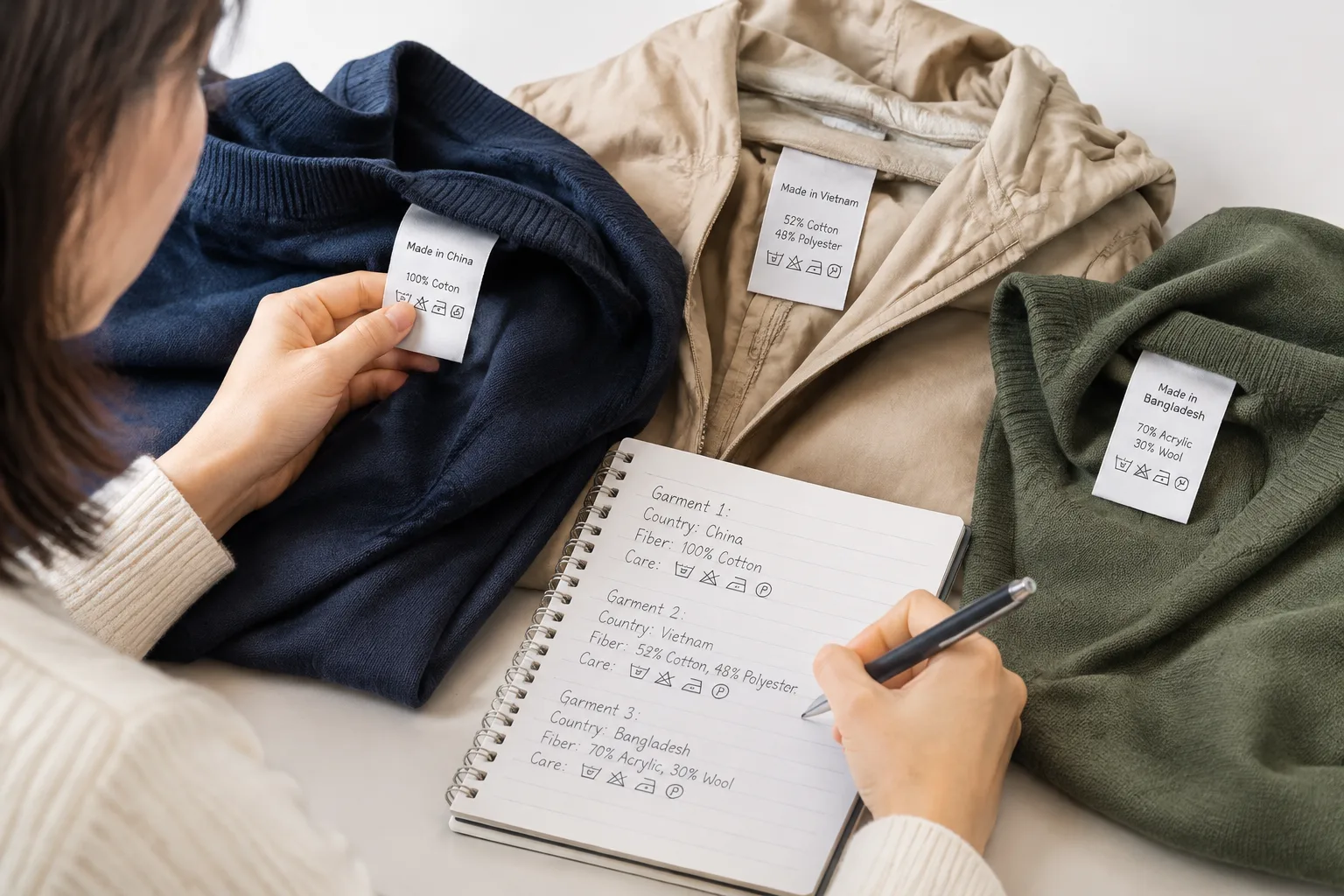
The most direct place to check a garment’s declared origin is its label. Read the wording carefully: brand identity, design location, fiber content, care instructions, and country of manufacture are different statements.
Locate the Origin Statement
Start with the permanent label inside the garment. Depending on the product, it may be at the back neck, side seam, waistband, pocket area, or another accessible location. Some garments use several labels, so inspect the full label set rather than stopping at the most visible brand tag.
Look for explicit wording such as Made in, Product of, or another origin statement required for the market where the item is sold. A hangtag or package may provide additional information, but removable marketing text should not automatically be treated as a substitute for the garment’s required labeling.
Distinguish Origin from Fiber and Care Information
For covered textile products sold in the United States, the label generally distinguishes fiber content, country of origin, and the identity of the responsible business, subject to product-specific exceptions. The garment may also carry separate care instructions. The Federal Trade Commission’s textile labeling guidance explains the US framework in more detail.
These fields answer different questions. A statement such as 100% cotton identifies fiber content, not where the cotton was grown or the fabric was made. A brand name identifies a business or label, not necessarily the manufacturer. Washing symbols explain care and do not establish origin.
Understand What the Label Does Not Reveal
A final origin statement is not necessarily a map of the entire supply chain. Fiber production, yarn spinning, fabric formation, dyeing, printing, cutting, sewing, finishing, and packaging can occur in different countries. The label may not name the fabric mill, subcontractors, trim suppliers, or particular factory involved.
Origin rules can also differ by product and sales market. Do not infer that one country performed every stage merely because it appears after Made in. If detailed traceability matters, additional records may be needed, such as supplier declarations, purchase documents, material records, or production-stage disclosures.
Record and Verify the Exact Wording
Use a simple 4-step check:
- Photograph the complete label set. Capture the permanent labels, hangtags, packaging, and any qualifying wording.
- Transcribe the statement exactly. Record phrases such as Made in, Designed in, Assembled in, or Made in X from imported fabric without shortening them.
- Separate each claim. List origin, fiber content, responsible-business identity, and care information as distinct fields.
- Check the destination market’s current rules. Consult the responsible regulator or a qualified compliance adviser for the particular product rather than assuming that US guidance applies worldwide.
This process establishes what the item declares and helps prevent marketing language from being mistaken for manufacturing origin. It does not independently prove every upstream stage, so requests for deeper supply-chain evidence should specify which material or process needs verification.
Why Global Clothing Production Keeps Changing
Clothing production is concentrated, but it is not fixed. Brands and importers continually balance product capability, available capacity, landed cost, delivery time, trade conditions, and disruption risk. That is why one company—or even one product line—may use several manufacturing countries.
Why Brands Use More Than One Country
Different locations may suit different products. One supplier cluster may be efficient for basic knitted garments, while another has stronger experience in tailoring, technical outerwear, embellishment, or short-run production. Dividing orders can also provide access to more capacity than one factory or country can offer.
Market proximity is another reason. A business may source predictable core products from a distant high-volume center while producing replenishment orders closer to the destination market. Multiple sourcing locations can reduce dependence on a single route, but they also increase coordination work and the risk of differences in fit, color, materials, or workmanship. Shared specifications and comparable approval procedures become essential.
What Causes Sourcing Locations to Shift
Production can move when wages, energy prices, exchange rates, freight costs, tariffs, or material availability change. Port disruption, political events, natural hazards, capacity shortages, and changes in import rules may also alter the balance between locations. At the same time, investment in worker skills, infrastructure, mills, and component suppliers can make an emerging production center more capable.
Not every response requires a permanent relocation. A buyer may temporarily redirect one order, add a backup supplier, move only final assembly, or keep production in place while sourcing fabric elsewhere. Claims that an industry has “left” one country should therefore be tested against the scale, product category, and duration of the change.
How to Distinguish a Trend from a One-Year Change
A fall in annual export value does not by itself prove that physical production permanently declined. The result could reflect exchange-rate movements, lower selling prices, a change in product mix, weak demand, inventory adjustment, or temporary shipping disruption. Likewise, higher export value can occur without an equivalent rise in garment quantity.
To evaluate a claimed sourcing shift, compare several years using the same product definition and reporting method. Check export value alongside physical quantities where compatible data exist, and examine major destination markets rather than one trade route alone. Capacity investment, supplier development, employment, and repeated brand sourcing decisions can provide supporting context, but each measure has its own limitations.
The practical next step is to choose the question you actually need answered—declared origin, final assembly location, fabric source, export leadership, or full landed-cost suitability—and then collect evidence designed for that question. No single ranking or garment label answers all 5.
To discuss your production requirements, request a manufacturing quote from Ninghow.
Frequently Asked Questions
Can the same clothing style be made in different countries?
Yes. A brand may allocate the same style to multiple factories or move later production runs when capacity, cost, delivery, or materials change. Different colorways or sales markets may also follow different routes. Check the origin label on the individual garment rather than assuming every item with the same style name or product code has the same origin.
Does “Designed in” identify where a garment was manufactured?
No. “Designed in” identifies a design location, not necessarily where fabric was produced or the garment was cut and sewn. Look separately for an explicit country-of-origin statement such as “Made in” or other market-appropriate wording. If the wording is unclear, record the complete label and consult the regulator responsible for the market where the item is sold.
How can online shoppers check origin before a garment arrives?
Review the product description, specifications, and clear photographs of the label, but do not assume the seller’s headquarters or shipping location is the manufacturing origin. Ask the seller for the exact origin wording for the specific item or batch. Because production can vary between batches, confirm the permanent label again when the garment arrives.