


Yes, different client logos can be organized in one polo shirts manufacturers order when the base garment specifications genuinely match. The practical structure is a shared garment program with separately reviewed decoration variants, not one undifferentiated order.
This distinction matters for distributors. Total polo quantity may help production planning, but it does not automatically combine every logo minimum, setup requirement, approval, packing instruction, or delivery destination. Start with the common polo specification, then assess each client variant from a complete matrix.
Yes, Different Logos Can Share One Polo Order—If the Base Specifications Match
A multiple-logo bulk polo order is workable when the clients share the same core garment: style, fabric route, color, fit, collar, placket, and size framework. The logos can then be treated as separate decoration variants attached to that shared base garment order.
That does not mean every requirement is combined. Artwork size, logo position, decoration method, label, packing, and destination may vary by client. A manufacturer must review those differences before confirming feasibility, pricing structure, setup requirements, or variant minimums.
The operating rule
Confirm the shared garment specification first. Then review each logo variant independently. Combining garment quantities may support a consolidated production plan, but it does not automatically make every logo eligible for one decoration MOQ or one commercial condition.
| Order layer | What may be shared | What still needs review |
|---|---|---|
| Garment | Style, fabric, color, collar, placket, fit, and size range | Any change that creates a different garment specification |
| Decoration | Possibly the method or placement when confirmed compatible | Artwork, size, colors, coverage, placement, and setup |
| Fulfillment | Potentially common labels or packing rules | Client IDs, carton marks, quantities, and destinations |
For a distributor, the safe quotation request is therefore a shared base garment brief plus a logo matrix. The matrix should show each client, artwork version, decoration method, placement, size mix, quantity, label, packing instruction, and destination. Feasibility, setup conditions, and minimum quantities should be confirmed against that complete document.
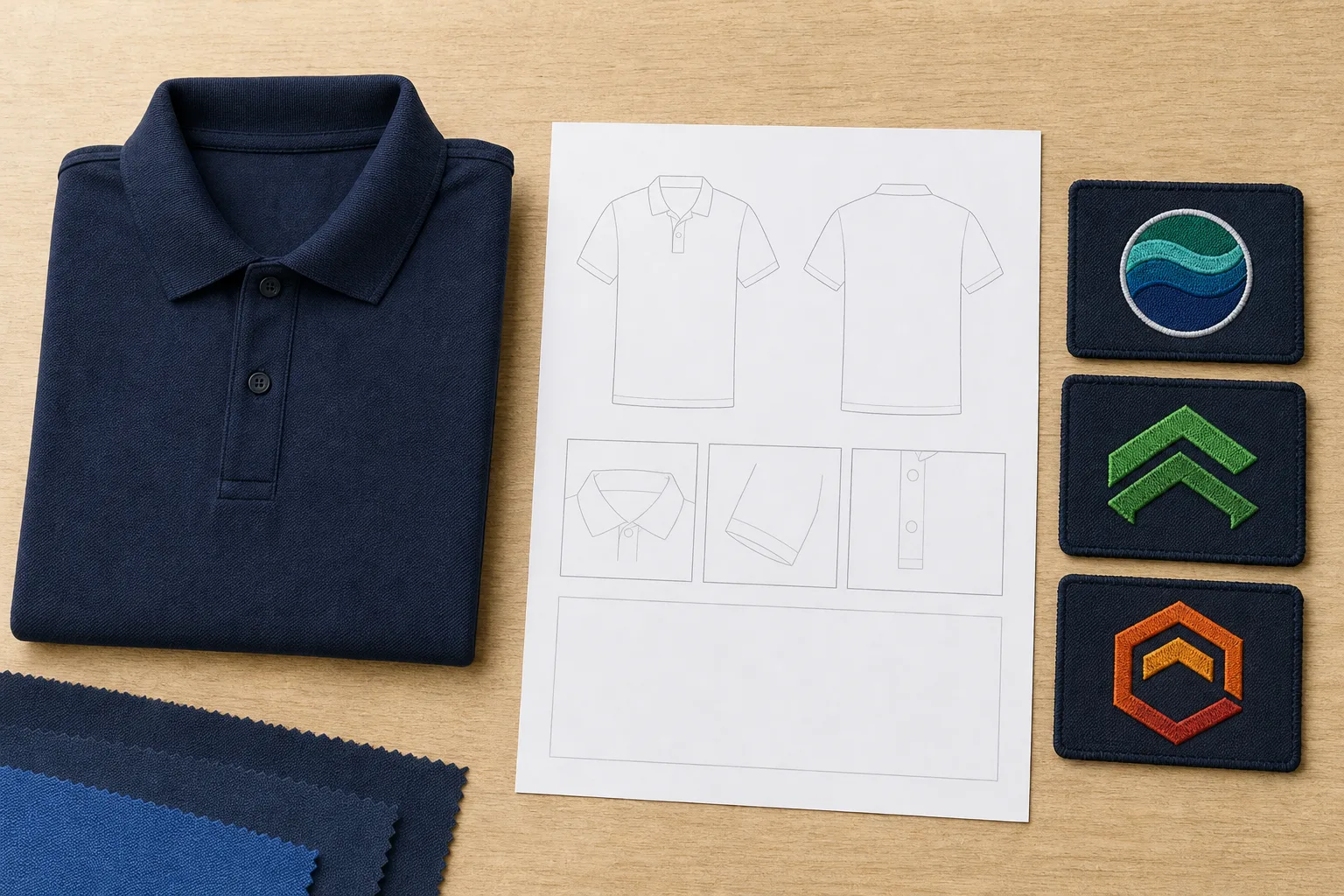
Separate Shared Garment Specifications From Logo-Specific Production Requirements
Separate the order into shared inputs and variable inputs before requesting a quote. Fabric, fit, collar, placket, branding, and size planning interact with one another, so a change in one area may affect whether the rows can remain in the same garment program.
| Specification | Initial classification | Buyer question |
|---|---|---|
| Base style and fabric | Shared or separate | Are all clients using the same construction and material route? |
| Color | Potentially shared | Are the requested colors identical, and are quantities shown by color? |
| Collar and placket | Shared only if identical | Will every client accept the same collar shape, trim, and placket details? |
| Fit and size range | Shared or separate | Is the size framework the same, with a separate size breakdown for each client? |
| Decoration method | Variant-specific | Does each logo require embroidery, printing, or another confirmed method? |
| Artwork, position, and coverage | Variant-specific | Are dimensions, colors, placement, and smallest details approved? |
| Label and packing | Potentially shared or variant-specific | Does each client need its own label, polybag instruction, carton mark, or destination? |
Different artwork sizes, positions, and colors can require separate review even on the same polo. Treat each logo as its own approval item when those details differ. Buyers should also include wash-care expectations and appearance checks for both the polo structure and the decoration; a fabric name alone does not define the finished result.
A change to the fabric, fit, collar, or placket should be treated as a possible new garment specification, even if the logos are similar. Before quoting, define the wear scenario, washing expectations, logo requirements, and size range. Ninghow’s polo sourcing page can serve as a starting point for discussing custom fabric, fit, collars, plackets, and branding, subject to project confirmation.
Use Two Buyer Scenarios to Test Whether Consolidation Is Practical
Use a simple decision test before presenting a consolidated order to clients: the garment specification must match, the decoration requirements must be compatible, quantities must be documented, and packing instructions must be controlled.
1. Hypothetical uniform-distributor scenario
Buyer situation: A uniform distributor has 3 offices requesting the same polo color, fabric route, fit, collar, placket, and size range. Each office wants a different chest logo in the same general position.
Available evidence: The distributor has a common garment brief, a quantity and size breakdown for each office, and separate artwork files with named approval contacts.
Evidence gap: The decoration method, artwork dimensions, setup conditions, logo-specific minimums, and packing workflow still need manufacturer review.
Outcome: Go, subject to confirmation. The garment portion is organized as one shared base program, while each office logo remains a separate decoration and approval variant.
2. Hypothetical promotional-products scenario
Buyer situation: A promotional-products distributor has 4 event clients requesting the same polo style but different colors, logo sizes, logo colors, and decoration methods.
Available evidence: The distributor has an overall quantity estimate and client artwork, but the quantities are not yet split by color, method, size, or destination.
Evidence gap: The combined total cannot establish whether each decoration variant meets its applicable minimum or whether the color and artwork combinations can follow one garment program.
Outcome: Clarify before quoting. Separate the rows by garment color and decoration variant. If the changes create different garment specifications or incompatible production requirements, treat them as separate programs rather than assuming one combined MOQ.
Build a Client, Logo, Color, Size, and Quantity Matrix Before Requesting a Quote
Build the matrix before asking for a quotation. Use one row for every unique combination of client, base style, garment color, logo version, decoration method, placement, size mix, quantity, label, packing instruction, and destination.
| Variant ID | Client | Color and size mix | Logo and method | Qty | Packing and destination |
|---|---|---|---|---|---|
| V-01 | Client A | Color 1; sizes by file | Logo A; method to confirm | Enter qty | Client A packing; enter destination |
| V-02 | Client B | Color 1; sizes by file | Logo B; method to confirm | Enter qty | Client B packing; enter destination |
| V-03 | Client C | Color 2; sizes by file | Logo C; method to confirm | Enter qty | Client C packing; enter destination |
Keep the variant ID attached to the artwork file, approval record, carton mark, and reorder reference. Record who owns the artwork and who gives final approval. Show garment totals separately from decoration totals, with subtotals by color, logo, method, size, and destination.
Before submission, flag missing artwork dimensions, logo colors, placement, size breakdown, label instructions, packing rules, or delivery requirements. The matrix is a handover document for feasibility review, not proof that a particular sorting, warehousing, or direct-shipping workflow is available. For broader preparation, buyers can also review Custom Apparel Manufacturing Planning: A Practical Guide for Brands and Apparel Buyers.
Compare Decoration Setup, Approval, and Minimums by Logo Variant
With the matrix completed, evaluate each decoration variant on its own terms. The shared base garment may be quoted as one group, but the logo work can still divide the order by method, artwork, placement, and quantity.
Separate the decoration variables
For every logo, record the requested method, artwork dimensions, placement, color count, small lettering, coverage, and client quantity. Embroidery, printing, patches, and other methods should not be treated as interchangeable until the manufacturer confirms that the artwork and polo surface are suitable. Different artwork sizes, positions, and colors can require separate technical review and approval, even when the garment is identical.
| Variant input | Why it affects review | Buyer action |
|---|---|---|
| Decoration method | Each method may have different setup and execution requirements. | List the requested method beside each logo. |
| Artwork size and placement | Small lettering, large coverage, and proximity to the collar or placket can change feasibility. | Provide measured dimensions and a placement reference. |
| Color and quantity | Color count and the number of pieces for each logo may affect the variant assessment. | Show each logo subtotal rather than only the combined garment total. |
| Client approval | Different clients may require separate visual sign-off. | Name the approving person and approval status. |
This is why combining logos does not necessarily reduce every MOQ. A garment minimum may apply to the shared style, while a decoration method, artwork setup, or individual variant quantity may be reviewed separately. The combined polo total cannot automatically satisfy each condition.
Ask for a grouped quotation that shows shared garment assumptions separately from decoration lines. A useful response should identify the base style, colors, and total garment quantities, then show each logo variant, method, sampling requirement, setup condition, label requirement, and packing instruction. Prices, setup fees, capacity, lead times, and actual minimums must be confirmed for the specific order rather than inferred from the total quantity.
Approve Logo Samples on the Actual Polo Before Bulk Release
Once each variant has been assessed, approve the logo on the actual polo before releasing bulk production. One approved logo does not automatically approve a second artwork version, a different garment color, or a different decoration method.
Use a version-specific approval record
Link every approval to the variant ID, artwork file, garment color, position, dimensions, decoration method, and approving person. Include the file version or date so an old approval cannot be confused with a revised logo. Written confirmation should identify exactly which combinations are approved and which remain pending.
Prioritize the variants most likely to expose a problem: the smallest lettering, the most detailed artwork, the largest coverage, the strongest contrast, and the garment color that changes the visual relationship. Check logo clarity, scale, placement, color relationship, distortion, and the way the decoration sits near the collar, placket, seams, or labels.
- Confirm the logo artwork and authorization for production.
- Check the measured position from fixed garment references, not only from a digital mockup.
- Compare the approved appearance with the actual polo color and construction.
- Record the approver, date, variant ID, and any conditions or open questions.
- Freeze the approved version before bulk material purchasing or production release.
Ninghow’s stated order-process description includes sample approval and order confirmation before bulk material purchasing. For a buyer, that sequence is useful as a control point, but it does not mean every revision is free or that a sample guarantees bulk performance without an appropriate order-specific check. Confirm sample fees, revision limits, testing needs, and timing in the quotation.
If a client changes the logo after approval, record the affected variants, artwork, materials, decoration assumptions, packing references, and commercial impact. Do not allow an informal message to replace the final written release.
Lock Variant IDs, Labels, and Packing Instructions Before Bulk Production
After approval, keep the same variant ID through production, labeling, packing, delivery, and reorder discussions. This is especially important when several clients use the same polo and differ only in logo, size mix, label, carton mark, or destination.
Define the final packing record
For each variant, confirm the client code, garment color, logo version, size breakdown, label, folding method, carton mark, destination, and quantity. Put these fields in the release matrix rather than relying on an email subject or a logo filename. Labels and packing instructions may differ even when the garment and decoration are shared.
| Control field | Example of what to record |
|---|---|
| Variant ID | Unique code connecting client, color, logo, and size mix |
| Identification | Client code, approved logo version, label instruction |
| Quantity | Size-level quantity and total units for that variant |
| Packing | Folding, assortment, carton mark, and any destination code |
| Release evidence | Approved artwork, sample record, final matrix, and written instructions |
Before copying instructions across the order, verify one controlled group or other agreed pre-bulk check for variant identification. Confirm how shortages, substitutions, mixed cartons, artwork changes, and quantity discrepancies will be recorded and approved. Do not assume that multiple logos automatically include client-by-client sorting, warehousing, or direct shipping.
Ask the manufacturer to confirm whether the requested labels, packing arrangement, destination handling, and identification method are available for the specific project. Retain the final artwork, approval records, sample photos or records, matrix, and packing references. These documents make a later client-specific reorder easier to compare with the original combination without treating the first order as an automatic capability guarantee.
Send a Complete Multi-Logo Polo Brief for Feasibility and Quotation
A manufacturer can assess a multiple-logo bulk polo order more accurately when the shared garment details and client-level variants arrive in one structured brief. Send the information below as a working quotation document, not as a general request for “custom polos with several logos.”
Multi-logo quotation checklist
- Base garment: reference sample or tech pack, fabric composition or route, garment colors, collar, placket, fit, size range, and care-label requirements.
- Quantities: total units, color totals, size breakdown, client-level quantities, and any expected reorder structure.
- Logo matrix: client code, artwork file, approved file version, decoration method, dimensions, placement, color information, small lettering, coverage, and logo quantity.
- Development: sample priorities, required approval people, artwork authorization, and any client-specific sign-off deadline.
- Finishing: woven or printed labels, hangtags, folding, assortment, packing codes, carton marks, and destination requirements.
- Commercial review: requested delivery destination, target timing for assessment, and which assumptions need separate confirmation.
Request the quotation in grouped lines: shared garment production; each decoration variant; sampling and approval; setup or artwork conditions; labels; packing; and delivery-related handling. Ask which quantities may be combined and which remain subject to separate variant evaluation. This format makes it easier to compare a genuinely consolidated order with a set of independent client requests.
Before sending the brief, check that every logo has a usable file, measured placement, color reference, quantity, and approving contact. Confirm that the size totals reconcile to the client and color totals, and assign a stable reorder reference to each variant. Buyers who need a broader preparation checklist can review what to prepare before buying clothing from China.
For a project review, send Ninghow the shared polo specification, colors and size totals, client-level quantities, complete logo matrix, artwork dimensions and placements, decoration methods, labels, packing instructions, destinations, and required approvals through the Ninghow contact page. The combination, variant conditions, and quotation assumptions remain subject to review.
Frequently Asked Questions
Can different client logos share one bulk polo order?
Yes, different client logos can share one bulk polo order when the base garment specifications match, including the relevant style, colors, construction, and size framework. The logos should still be treated as separate decoration variants, with their own artwork, placement, quantity, approval, and packing requirements confirmed.
Does combining logos reduce every MOQ?
No. Combining logos may consolidate some garment requirements, but it does not automatically reduce every minimum. Decoration method, artwork setup, logo-specific quantity, sampling, labels, and packing may be assessed separately. Ask for garment totals and decoration-variant conditions as distinct quotation lines.
Does each logo need a separate sample approval?
Each materially different logo should receive its own approval record, especially when artwork size, placement, color, lettering, coverage, or decoration method changes. A shared base polo sample can confirm the garment, but it does not automatically approve every logo variant or client-specific application.
How should distributor client variants be packed?
Pack variants using unique IDs linked to the client, garment color, logo version, size breakdown, label, carton mark, destination, and quantity. Confirm sorting, mixed-carton rules, and destination handling in writing. Do not assume that several logos include client-level packing or direct shipping.
What information should a distributor include in a multi-logo polo quotation request?
Include the base polo specification, colors, size range, total and client-level quantities, artwork files, logo dimensions, placements, decoration methods, labels, packing instructions, destinations, approval contacts, and reorder references. Ask the manufacturer to separate shared garment assumptions from each decoration variant and project-dependent condition.
Can different garment colors share one base polo order?
Possibly, but different colors should be listed separately because color quantities, artwork contrast, decoration appearance, and material availability may affect the assessment. Treat colors as part of the garment and logo matrix, then ask which color quantities can be combined under the specific quotation.