




Custom apparel manufacturing works best when product decisions are made in the right order. Before requesting a quote, brands and apparel buyers need to define the garment, target wearer, fabric performance, fit, decoration, private label details, order volume, and quality expectations. A clear plan helps manufacturers price the project accurately, identify production risks early, and develop samples that are useful for approval rather than simply attractive prototypes.
For brands planning coordinated fleece collections, custom hoodie manufacturing support for coordinated apparel programs can help connect garment selection, fabric decisions, fit development, decoration, and bulk production planning. At Ninghow, we use the same development logic for hoodies, joggers, T-shirts, polos, jackets, sportswear, and other private label products.
Start With the Product Goal and Use Scenario
The first planning decision is not the fabric or logo. It is the role the garment must perform. A retail fashion hoodie, a school team sweatshirt, a golf polo, and a high-activity training top may all be called custom apparel, but they require different materials, construction details, decoration methods, and testing priorities.
Define who will wear the garment, where it will be used, how often it will be washed, and what the buyer expects to pay. Also record whether the product is intended for retail, uniforms, promotional distribution, teamwear, e-commerce testing, or a long-term core collection. These answers guide nearly every later manufacturing decision.
- Target customer and expected wearing environment
- Garment category and intended season
- Performance requirements such as stretch, breathability, warmth, or abrasion resistance
- Expected order quantity by style, color, and size
- Target cost range and acceptable cost-performance trade-offs
- Required launch date, replenishment plan, and delivery destination
A useful product brief should distinguish non-negotiable requirements from preferences. For example, colorfastness, a specific chest measurement, and a required care label may be mandatory, while a particular drawcord finish or packaging format may be adjustable if it affects cost or timing.
Key takeaway: A manufacturer can develop a more reliable quotation and sample when the buyer explains the garment’s commercial purpose, not just its visual appearance.
Choose the Garment Category Before Finalizing Details

Garment selection affects fabric consumption, pattern shape, sewing operations, decoration area, packaging volume, and production capacity. Buyers should confirm the base category before sending artwork because a logo that works on a flat T-shirt may need adjustment for a hood, curved side panel, rib cuff, or technical seam.
| Garment category | Important planning factors | Common buyer priorities |
|---|---|---|
| T-shirt | Jersey weight, neckline recovery, shrinkage, print area | Soft hand feel, fit consistency, retail cost |
| Polo shirt | Collar construction, placket, piqué or jersey structure | Shape retention, professional appearance, embroidery |
| Hoodie or sweatshirt | Fleece weight, hood shape, rib tension, pocket construction | Warmth, coordinated sets, durable decoration |
| Jacket | Layering ease, lining, zipper, seam sealing, trims | Weather protection, construction quality, trim reliability |
| Sportswear | Stretch, recovery, moisture management, panel layout | Mobility, breathability, low-friction seams |
| Team apparel | Size distribution, repeatability, names and numbers | Consistent colors, simplified ordering, delivery control |
For a first collection, it is often more efficient to select a coherent product family. A hoodie, jogger, and T-shirt using related colors and compatible fabric stories can share artwork, labels, packaging concepts, and merchandising logic. However, the garments may still need separate patterns, fit approvals, and decoration testing.
At this stage, buyers should also decide whether they want a stock-inspired product with custom details or a fully developed cut-and-sew style. The first route may reduce development complexity, while the second provides more control over silhouette, panels, proportions, and construction.
How to Select Fabric Composition and GSM
Fabric selection should balance performance, hand feel, appearance, durability, availability, and cost. Composition describes the fiber content, while GSM describes fabric weight in grams per square meter. Neither factor alone determines quality. A lighter fabric can be appropriate for a breathable summer garment, while a heavier fabric may be needed for warmth or a structured silhouette.
| Fabric decision | What it influences | What to confirm before sampling |
|---|---|---|
| Fiber composition | Hand feel, care behavior, moisture response, durability | Exact percentages and whether the composition applies to all colors |
| GSM | Weight, opacity, warmth, drape, shipping volume | Finished fabric weight and acceptable tolerance |
| Stretch and recovery | Mobility, fit retention, comfort | Direction of stretch and recovery after wear or washing |
| Finish | Surface appearance, softness, performance, color effect | Finish consistency and care instructions |
| Color and dye route | Shade accuracy, minimums, lead time | Lab dip process, approved reference, and color tolerance |
We recommend reviewing fabric swatches under realistic lighting and comparing them with the intended garment structure. A fabric that feels suitable as a loose swatch may behave differently after washing, printing, embroidery, or being sewn into a fitted pattern. Rib, interlock, fleece, mesh, and woven fabrics also require different construction assumptions.
Color planning deserves early attention when several garments form a set. If the hoodie and jogger must match, the buyer should confirm whether they can use the same dye lot, a shared approved color standard, or a controlled custom dye process. For collections with strict color coordination, custom fabric dyeing for consistent set colors may be relevant during development.
A standardized reference can help organize the sizing discussion. For example, ASTM provides standardized body measurements for apparel sizing, but such tables are only a starting point. Brands still need their own blocks, ease values, garment measurements, and grading rules for their target customer and product category.
Build Fit, Measurement, and Grading Into the Plan
Fit problems are among the most expensive issues to discover after bulk production begins. A tech pack should include a measurement chart with points of measure, tolerances, base size, grading increments, and clear diagrams or written definitions. Do not rely only on a sample photo or a general instruction such as “make it oversized.”
Decide whether the desired fit is slim, regular, relaxed, boxy, athletic, cropped, longline, or unisex. Then describe how the garment should sit on the body. For sportswear, mobility through the armhole, shoulder, rise, inseam, and side panels may be more important than a simple chest measurement.
Our sample review process typically looks at the garment on a suitable fit model and on a flat measurement table. Both views matter. A garment can match several measurements but still look unbalanced because of shoulder angle, sleeve pitch, neckline position, pocket height, or hem proportion.
- Approve a base size before grading the complete size range
- Define tolerances for key measurements rather than expecting identical numbers
- Check shrinkage and wash behavior before finalizing the chart
- Review grading between adjacent sizes for proportion, not only arithmetic increments
- Confirm whether the same block is suitable for men, women, youth, or unisex use
For coordinated products, fit relationships are also important. A hoodie and jogger may use different fabrics or blocks, but the rise, hem width, body length, and overall visual volume should appear intentional when worn together. cut-and-sew support for aligned hoodie and jogger fits can help buyers manage those relationships during development.
Prepare a Tech Pack That a Factory Can Use
A production-ready tech pack converts creative intent into instructions that can be measured, sampled, and inspected. It should be specific enough for a manufacturer to identify what must be reproduced and what can be adjusted after review.
Include front, back, and detail drawings, fabric composition, GSM, color references, measurement charts, construction notes, stitch requirements, seam details, artwork files, placement measurements, labels, trims, packaging, and care instructions. If a detail is not shown, state whether it is open for development or should follow the manufacturer’s standard.
Artwork should be supplied in an appropriate production format with dimensions, colors, and placement references. A logo’s visual size can change depending on whether it is embroidered, screen printed, transferred, woven, or applied as a label. Buyers should approve a decoration strike-off or print sample before treating the artwork as final.
Private label planning should be included from the beginning. Neck labels, size labels, care labels, hangtags, polybags, carton marks, folding instructions, and barcode requirements can affect the production schedule. Late changes to trims often create more disruption than late changes to a simple artwork file.
From our manufacturing perspective, the most useful tech packs separate approved specifications from questions still under discussion. This makes quotations clearer and prevents a provisional detail from being mistaken for a final production instruction.
Compare Decoration and Branding Methods
The right customization method depends on artwork complexity, fabric surface, order quantity, color count, expected durability, and the desired hand feel. No single decoration process is suitable for every garment.
| Method | Strengths | Planning considerations |
|---|---|---|
| Screen printing | Strong for bold graphics and repeatable larger runs | Color count, setup, ink feel, and print registration |
| Heat transfer | Useful for detailed graphics and names or numbers | Film hand feel, heat compatibility, and wash durability |
| Sublimation | Suitable for polyester graphics integrated into the fabric | Usually requires compatible light-colored polyester surfaces |
| Embroidery | Creates a dimensional, premium identity | Stitch density, backing, puckering, and small-detail limits |
| Woven or printed labels | Supports private label presentation and inside branding | Label dimensions, fold type, attachment, and lead time |
Decoration should be tested on the actual fabric, not only on paper or a different blank garment. Fleece, rib, brushed surfaces, stretch jersey, and coated fabrics can all affect registration, adhesion, puckering, or visual sharpness.
When products include individual names, numbers, or multiple logo positions, the buyer should provide a controlled artwork list and approval process. A simple matrix showing style, color, size, decoration position, and personalization requirement can prevent production confusion.
Understand the Development Process Before Ordering
Custom apparel manufacturing normally moves through a sequence of brief, quotation, material review, pattern development, prototype sampling, revisions, approval, bulk planning, production, inspection, and packing. The exact workflow varies by product, but the approval gates should be clear.
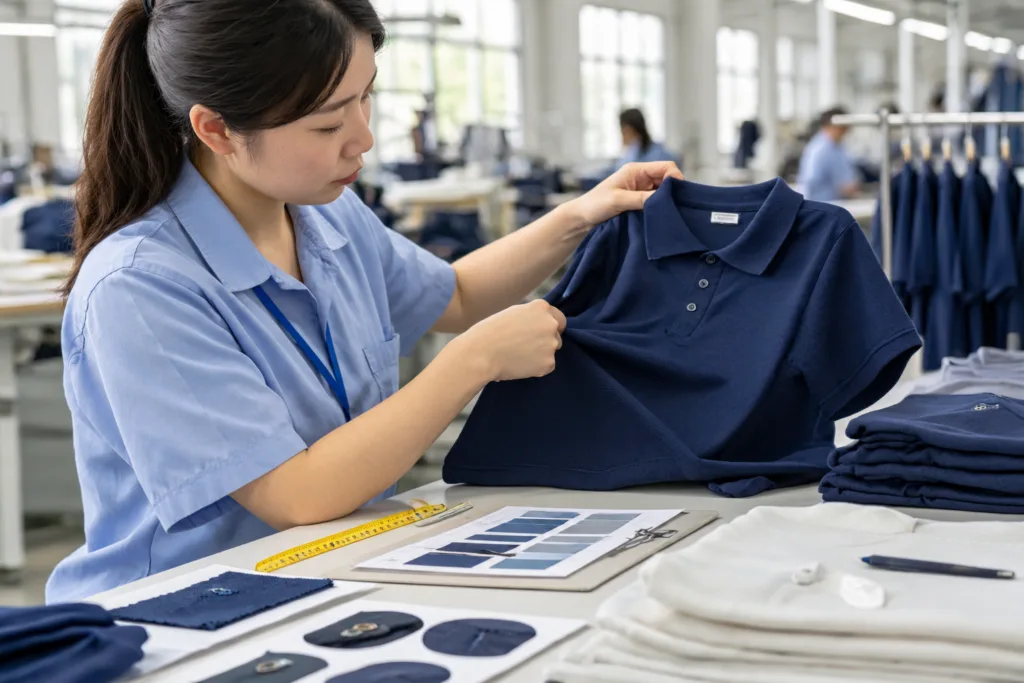
The first sample is a learning tool, not automatically a final production reference. It may reveal that the fabric is too heavy, the hood opening is too narrow, the sleeve needs more mobility, or the artwork needs a different application method. Buyers should record each revision in writing and identify which changes affect cost or timing.
For coordinated products, apparel sampling for matching hoodie and jogger development can help organize fabric, fit, and appearance decisions across multiple styles. We recommend approving the final fabric, color, artwork, measurements, trims, and packaging details before bulk cutting begins.
Sample approval should include photographs, comments, a dated measurement chart, and a clear statement of what has been accepted. If the buyer approves by message but later sends a different file or measurement table, the manufacturer may be working from conflicting instructions.
Plan MOQ, Cost, and Lead Time Together
MOQ is not simply a factory preference. It is influenced by fabric availability, dyeing requirements, trim minimums, artwork setup, production efficiency, and the number of color and size combinations. A style using available fabric may be easier to produce at a lower quantity than a style requiring custom dyeing and specially made trims.
| Cost or timing driver | Why it matters | Buyer planning response |
|---|---|---|
| Custom fabric | May require minimum yardage and dyeing time | Confirm color quantities before development |
| Multiple colors | Increases material and cutting complexity | Prioritize core colors for the first run |
| Complex construction | Adds operations and inspection points | Allow more sampling and production time |
| Custom trims | May have separate supplier minimums | Approve labels and packaging early |
| Individual decoration | Requires sorting and additional handling | Provide accurate artwork and personalization files |
Low MOQ can be useful for collection testing, but smaller quantities do not always produce the lowest unit cost. Setup, sampling, trims, and material purchasing are spread over fewer garments. A buyer should compare total project cost, cash exposure, and replenishment flexibility rather than focusing on unit price alone.
Lead time should be separated into material preparation, sampling, approval, bulk production, decoration, inspection, and shipping. A rushed launch often results from counting only sewing days while ignoring sample revisions, custom fabric, label production, or buyer approval time.
Set Quality Control Checkpoints
Quality control is more effective when it is built into the process rather than left to final inspection. A manufacturer and buyer should agree on what will be checked, against which approved reference, and how defects or deviations will be handled.
- Fabric inspection for color, weight, width, surface defects, and shade consistency
- Cutting checks for panel accuracy, grain direction, and size separation
- Sewing checks for seam construction, skipped stitches, puckering, and attachment quality
- Decoration checks for position, size, color, adhesion, stitch density, and registration
- Measurement checks against the approved chart and tolerance range
- Finishing checks for loose threads, pressing, stains, labels, folding, and packing
- Final carton checks for style, color, size quantity, shipping marks, and documentation
Buyers should define critical defects separately from minor cosmetic issues. A wrong size label, open seam, or incorrect color may require different action from a small thread tail. Photos and written inspection records make decisions easier when several stakeholders are involved.
For buyers evaluating a supplier’s process, apparel quality control for consistent sizing and production provides a useful reference point for discussing checkpoints and acceptance expectations. Ninghow approaches quality as a series of controls across materials, construction, decoration, measurements, and packing rather than as a single final glance.
Evaluate the Manufacturer and Communication Process
A suitable clothing manufacturer should be evaluated on process fit, not only on a product gallery or a low quotation. Ask what products the factory regularly makes, which operations are handled internally, how samples are documented, how fabric and trims are approved, and how production changes are controlled.
Request evidence that is relevant to your project, such as anonymized measurement sheets, sample comments, decoration tests, production photos, or an explanation of inspection stages. Certifications may be useful when they apply to the required material, market, or process, but buyers should verify scope and validity instead of treating a certificate name as a complete quality guarantee.
Communication quality is a production capability. The supplier should be able to restate the brief, identify missing information, explain cost drivers, flag unrealistic deadlines, and confirm who approves changes. A factory that agrees to every request without discussing material, capacity, or timing may create more risk than one that asks precise questions.
Ninghow supports apparel development and bulk production planning by connecting fabric selection, sampling, customization, private label details, and quality considerations in one manufacturing discussion. The practical objective is to create a shared production reference that both the buyer and factory can use.
Common Planning Mistakes That Delay Orders
Most avoidable delays come from incomplete information or late decisions. The following mistakes are especially common in first collections and custom teamwear programs.
- Requesting a price without specifying fabric, decoration, measurements, or packaging
- Approving a sample visually while ignoring flat measurements and construction details
- Changing the size chart after grading or bulk cutting has started
- Using a screen image as the only color reference
- Sending artwork without dimensions, application method, or placement instructions
- Assuming one sample represents every color, size, and decoration variation
- Setting a launch date without allowing time for revisions and buyer approvals
- Ordering custom labels and packaging after the garment production schedule is fixed
- Comparing quotations that include different fabrics, trims, inspection scopes, or shipping assumptions
When a mistake is found, the fastest response is usually to isolate the affected specification, assess whether it changes the approved sample, and update the production record. Broad informal instructions can create uncertainty across pattern, purchasing, sewing, and packing teams.
Use a Production-Ready Buyer Checklist
Before approving bulk production, buyers should be able to answer the following questions without relying on memory or scattered messages.
- What is the exact garment category, target wearer, and use scenario?
- Are composition, GSM, finish, stretch, and color references approved?
- Is the base size fit approved, and is the full grading chart documented?
- Are construction details, seam types, measurements, and tolerances clear?
- Are artwork files, decoration methods, and placement measurements final?
- Are labels, hangtags, care instructions, packaging, and carton marks approved?
- Are MOQ, order quantity by color and size, and material minimums understood?
- Are sample revisions and final approvals recorded with dates?
- Are inspection checkpoints and defect expectations agreed?
- Are production, decoration, inspection, and shipping timelines realistic?
Ask the manufacturer to identify any unresolved item before bulk materials are committed. In our experience, a short clarification at this stage is far less disruptive than changing a pattern, color, trim, or decoration method after production has begun.
Questions to Ask Before Approving Bulk Production
Use these questions to make supplier discussions more practical and comparable.
- Which parts of the product are standard, and which parts require new development?
- What fabric and trim minimums apply to each color and style?
- Which sample will serve as the bulk production reference?
- How will size measurements and tolerances be checked?
- What happens if the approved fabric or trim is unavailable?
- How are decoration tests approved before the full order?
- Which quality checkpoints are completed before packing?
- How are changes documented after quotation and sample approval?
- What information is needed to support repeat orders?
Key takeaway: The strongest supplier relationship is based on a shared, measurable production brief. Clear specifications help both sides balance quality, cost, MOQ, timing, and manufacturing practicality.
Conclusion: Turn the Brief Into a Controlled Production Plan

Successful custom apparel manufacturing starts with disciplined planning. Define the product goal, select the garment category, specify fabric and GSM, develop a measurable fit, prepare a usable tech pack, test decoration, and approve samples against written criteria. Then connect MOQ, lead time, private label details, and quality control to the same production reference.
Brands and apparel buyers do not need to eliminate every development decision before speaking with a manufacturer. They do need to identify the important decisions, communicate them clearly, and leave enough time for professional sampling and revision. A practical manufacturing partner can help test assumptions, but the final product succeeds when the buyer’s commercial goal and the factory’s production instructions are aligned.
Frequently Asked Questions
What information should I send a custom apparel manufacturer first?
Send the garment category, target use, reference images or drawings, fabric expectations, estimated quantities, size range, decoration requirements, delivery timing, and private label needs. A complete brief helps the manufacturer identify missing specifications and prepare a more realistic quotation.
How does GSM affect a custom garment?
GSM affects fabric weight, warmth, opacity, drape, shipping volume, and hand feel, but it does not define quality by itself. The correct GSM depends on the garment category, climate, fit, fabric composition, finishing, and intended use.
When should I approve the size chart?
Approve the base size through sampling before final grading and bulk cutting. The chart should include points of measure, tolerances, grading increments, and any shrinkage or wash adjustments so the factory can check production consistently.
Is low MOQ always the most cost-effective option?
Low MOQ can reduce inventory exposure and help test a collection, but setup, custom fabric, trims, sampling, and decoration may create a higher unit cost. Compare total project cost and future replenishment flexibility rather than unit price alone.
How many samples are needed before bulk production?
The number depends on garment complexity and the number of changes required. A sample may be followed by fit, fabric, color, decoration, or pre-production approvals; bulk production should begin only after the relevant specifications and reference sample are documented.
What should I check when evaluating a clothing manufacturer?
Check relevant product experience, fabric and trim sourcing, sampling workflow, measurement control, decoration capability, quality checkpoints, communication practices, MOQ logic, capacity, and ability to support repeat orders. Ask for project-relevant production evidence instead of relying only on general claims.