








Introduction: Why Dual Sourcing & Split Orders Matter in 2026 Apparel Strategy
Global apparel brands know firsthand the stakes of supply chain risk. The strategy of dual sourcing apparel—working with more than one factory or supplier—paired with split purchase orders, is reshaping how smart brands manage costs, compliance, and delivery times. This transition plan focuses on dual sourcing and split order tactics, offering practical steps to balance risk, orchestrate smooth factory transitions, and safeguard your fashion business.
What Is Dual Sourcing in Apparel? Fundamentals Explained

Dual sourcing apparel means partnering with two (or more) suppliers for the same product line, running purchases in parallel. It’s a move beyond single-source risk, aiming for flexibility, price competition, and supply reliability. Factory selection is critical—the transition plan emphasizes mapping out supplier strengths, technical capacity, and geographic location.
Key Benefits of Dual Sourcing
- Reduces impact of delays or disruptions from a single supplier
- Improves bargaining power on cost and quality
- Speeds up market entry with split production schedules
Common Pitfalls to Avoid in Dual Sourcing
- Quality inconsistency between factories
- Misalignment of delivery deadlines
- Communication breakdowns in tech pack interpretation
Split Orders Explained: Structure, Timing, and Key Considerations
A split order divides a purchase quantity between two suppliers—often staggered or synced to match capacity, risk, or required delivery. Apparel brands use this to test new factories, spread risk, and gently phase out legacy suppliers.
| Order Method | Benefits | Drawbacks |
|---|---|---|
| Single PO, Single Factory | Simplicity, consistent quality | High risk, slower response |
| Split PO, Two Factories | Risk spread, factory performance benchmarking | Coordination complexity, potential QC gaps |
| Staggered Order Launch | Test runs, phased entry for new suppliers | Potential timing mismatch, logistics challenges |
Strategic Transition: Gradual Shift vs Abrupt Supplier Change
Managing the pace of a factory exit (旧厂退出节奏) is as important as onboarding a new supplier. Rushed transitions risk lost sales, while drawn-out dual sourcing can be costly. Brands often start by splitting orders 70/30 or 50/50, then adjusting as new supply partners prove themselves.
Supply Transition Timeline: What to Expect
- Month 1-2: Sampling and initial split order (low volume)
- Month 3-4: Bulk split order, side-by-side QC comparison
- Month 5+: Volume adjustment, old supplier phase-out begins
Risk Isolation: Why Split Orders Minimize Losses
Risk isolation isn’t just theory. If one supplier hits trouble—production delay, raw material problem, or QC failure—the backup factory ensures at least partial delivery. This is vital for launch cycles, retail deadlines, and protecting cash flow.
Real-World Apparel Risk Scenarios
- Unexpected government restrictions in one region
- Factory labor shortages
- Material rejection at import/export stage
Splitting orders enables brands to pivot fast, rerouting future demand to the supplier who delivers reliably.
How to Select Your Dual Sourcing Factories
Choosing partners is about more than price—the decision shapes your product’s fit, finish, and delivery reliability. Apparel Manufacturer Evaluation Checklist helps screen for capacity, compliance, and technical fit with your brand.
- Assess historical OTIF (on-time-in-full) rates
- Compare technical strengths: stitching, pattern cutting, specialty processes
- Review certification and audit results (see Factory Audit Checklist)
Order Quantity Strategy: MOQ, Volume Split, and Negotiation
Minimum Order Quantity (MOQ) negotiation changes when dual sourcing. Brands must balance cost targets with practical batch sizes. Learn about smart MOQ strategies in the MOQ Negotiation Guide.
- Negotiate MOQ flexibility with both suppliers
- Test volume splits with initial small orders
- Pilot run can reveal supplier strengths and weaknesses
Volume Split Formula
| Stage | Old Factory (%) | New Factory (%) |
|---|---|---|
| Pilot | 70 | 30 |
| Main Split | 50 | 50 |
| Final Stage | 20 | 80 |
Communication SOP for Dual Sourcing Apparel
Clear supplier communication SOP (standard operating procedure) is your touchstone for preventing split order chaos. Early prepping of shared tech packs, fit samples, and spec sheets is crucial.
- Standardize tech pack deliverables
- Schedule staged communication reviews
- Monitor compliance updates from both suppliers
Ensuring Fit & Quality Consistency Between Factories
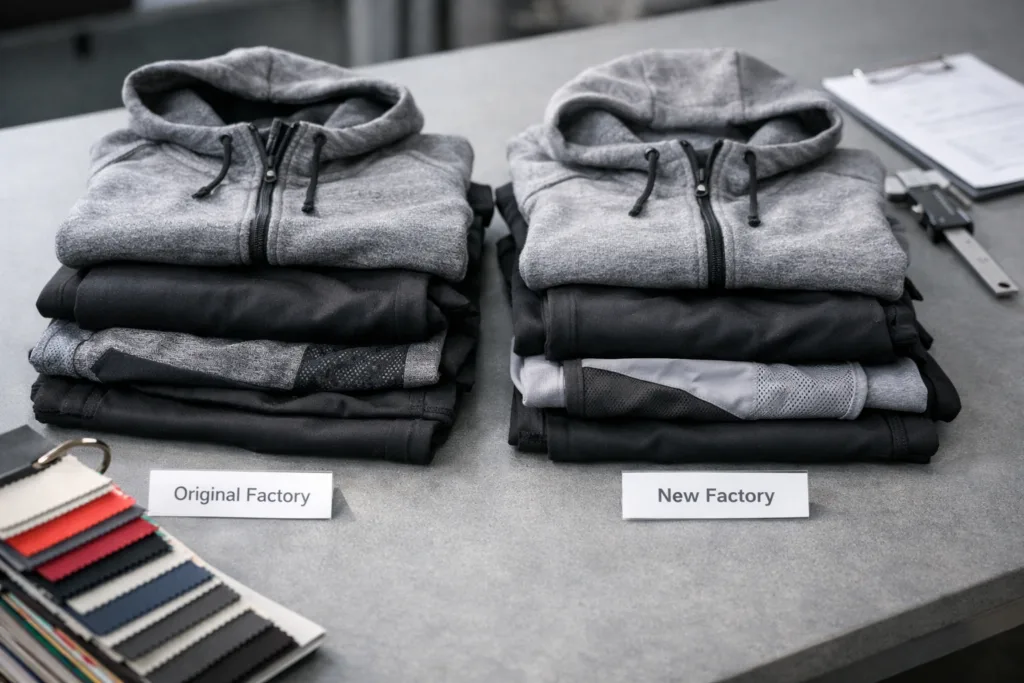
Fit accuracy and stitching consistency decide whether dual sourcing works for fashion brands. Sample approvals and reference garments help create a baseline for all suppliers. Practical tip: coordinate fitting sessions and cross-factory QC benchmarks.
Ninghow Tip:
As a garment manufacturer, Ninghow recommends using shared master patterns, standardized trims, and joint QC sessions before production. This reduces risk of unwanted product variance between suppliers.
Fabric & Trims Coordination: What To Watch For
Consistent look and feel across split orders depends on material coordination. Resolve fabric sourcing—weight, dye lot, finish—and trims up front.
- Provide pre-approved fabric swatches to both suppliers
- Specify source mills in PO and tech pack
- Confirm trims (zippers, labels, buttons) meet brand spec
AQL & In-Line QC: Split Order Inspection Flow
Rigorous quality checks underpin split order success. Use AQL (Acceptable Quality Level) standards for bulk shipments. Consider in-line QC for early detection.
- Schedule mid-production inspection for both factories
- Align inspection protocols (see Inline QC vs Final Inspection)
- Compare defect rates side by side
Staggered Delivery Schedules: Minimum Disruption
Staggered delivery timing controls inventory risks. By planning first batch arrivals from the proven factory, then adding new supplier as trust grows, brands avoid “all eggs in one basket” moments.
Staggering in Practice
- Pilot batch ships early—tests new factory’s reliability
- Main batch follows: mix of old and new suppliers
- Adjust future POs based on performance logbook
Compliance, Testing, and Labeling: Don’t Drop the Ball
Compliance headaches multiply when split ordering. Track component origins, certification, and labeling per region. Establish uniform compliance protocols, leveraging the Apparel Compliance Checklist for best practices.
- Test fabric and trims at source, not just finished goods
- Unify care labels and composition tags
- Keep compliance logs centralized for audit
Transition Plan: Dual Sourcing & Split Orders
Building your transition plan starts with documenting current production, projected order splits, and a phase-out schedule for legacy suppliers. Establish milestone reviews at each split order cycle to assess risk, cost, and supplier performance.
Transition Plan Checklist
- Identify trusted backup supplier
- Create pilot split order (with measurable outcomes)
- Document all spec differences and QC checkpoints
- Set phase-out targets for old supplier(s)
- Monitor dual sourcing budget impacts
- Review, adjust, and repeat until new supplier is proven
Factory Exit Pace: Managing Old Supplier Phase-Out
How quickly you phase out an old supplier depends on their performance, contract terms, and new supplier readiness. Maintain open, factual communication—abrupt exits risk legal and inventory headaches. Brands typically shrink order volume over 2–4 cycles, ending with “last buy” orders for seasonal products.
Toolbox: Templates and Resources for Split Orders
Equip your team with editable RFQ forms, order split calculators, and supplier scorecards. For apparel brands, templates like the Apparel RFQ Template streamline clear communication and tracking.
- Split order timeline spreadsheet
- Supplier performance dashboard
- Dual source risk assessment matrix
Cost Implications & Budget Allocation
Dual sourcing typically brings short-term duplicate costs (sampling, testing), but long-term savings offset single-source risk premiums. Track each supplier’s cost structure, payment terms, and incidental surcharges to avoid surprises.
Real-World Apparel Dual Sourcing: Success Case Studies
Brands that successfully transition to split orders often see reduced stockouts, higher quality rates, and better leverage in future negotiations. One streetwear brand phased out a Southeast Asian supplier over 3 split order cycles, noting a 17% drop in delivery variance and 8% improved QC scores with dual sourcing.
Managing Supplier Relations for Long-Term Wins
Keep open lines with both legacy and new suppliers. Transparency about split strategy signals professionalism and enables collaborative problem-solving, whereas concealment fosters mistrust and error.
Technology & Traceability: 2026 Tools for Efficient Apparel Sourcing
2026 garment brands deploy order management platforms, digital QC logs, and real-time shipment trackers for seamless split order oversight. Some use blockchain-backed tracing systems for compliance assurance.
Summary: Action Steps for Dual Sourcing Success

Dual sourcing apparel via split orders is not just a trend—it is core resilience for brands in 2026. Start gradual, focus on communication and QC, and review supplier output with every order. Your transition plan is key to unlocking stable, competitive apparel production.
Frequently Asked Questions
How do I avoid quality inconsistency in split orders?
Use unified tech packs, shared fit samples, and regular QC comparisons between suppliers to ensure product consistency.
What’s a safe starting split for dual sourcing?
Most brands start with a 70/30 or 60/40 split, allowing performance benchmarking before increasing order share for the new supplier.
How do I manage compliance across two factories?
Send a standardized compliance checklist, test trims and fabrics at both sources, and centralize all certification records for review.
What is the best timing for factory phase-out?
After at least two split order cycles with successful QC and on-time delivery from the new supplier, gradually reduce volume to the old supplier.
Does dual sourcing increase my costs?
Upfront costs for samples and QC rise, but mid-term gains in delivery reliability and cost negotiation usually outweigh the initial expense.
Should I inform old suppliers about split orders?
Yes. Transparency builds trust and enables smoother transition, reducing resistance and risk of supply disruption.