

Before sampling, review an AI-generated clothing tech pack for agreement between drawings and specifications, defined measurements and grading, confirmed materials and construction, executable decoration details, and clear budget and approval ownership. Treat it as a draft—not a production-ready instruction set—until a qualified technical reviewer has checked those areas.
The goal is not to make the document look more polished. It is to replace guesses with approved requirements, identify what the sample must resolve, and prevent a factory from making unpriced decisions on your behalf.
AI Tech Pack Review Checklist: Stop Before Sampling and Verify These Five Areas
Use this AI tech pack review checklist as a release gate. A complete-looking PDF is not evidence that its specifications are correct. A photo or AI flat can communicate design intent, but it cannot by itself establish measurements, tolerances, hidden construction, or approved materials.
| Review gate | Evidence to request | Reason to stop |
|---|---|---|
| Visual-to-specification consistency | Annotated flats matched to written details | Drawings and notes conflict |
| Measurements and grading | Defined measurement chart and approved size rules | Dimensions have no verified basis |
| Materials and construction | Component descriptions and construction callouts | Material or assembly choices remain guesses |
| Decoration and labeling | Artwork, dimensions, placement, and label copy | Instructions cannot be executed consistently |
| Budget and approval ownership | Agreed sample scope and named decision-makers | Development work or approval responsibility is unclear |
Copyable review record
Style: ___; file revision: ___; review date: ___; technical reviewer: ___; named approver: ___; open questions: ___; assumptions requiring confirmation: ___; affected pages: ___; sample scope and cost approval: ___; decision: Pass / Revise / Hold.
Pass means instructions are sufficiently defined for the agreed sample scope, not approved for bulk production. Revise means specific corrections are required before release. Hold means a critical unknown prevents meaningful sampling. Keep a dated technical redline alongside the corrected file so reviewers can trace each resolved issue.
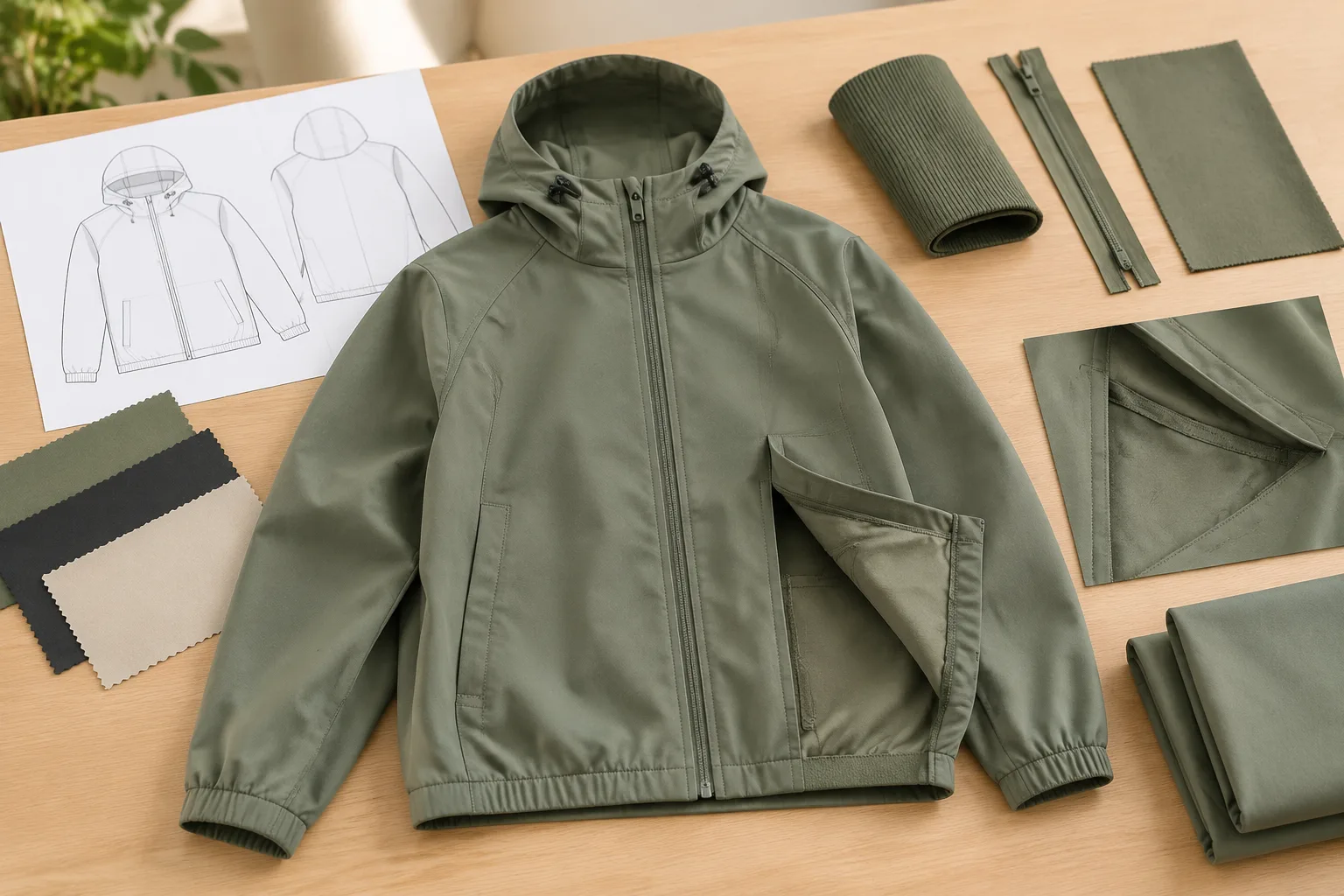
Reconcile the AI Flats, Bill of Materials, and Construction Details
Read the flat, bill of materials (BOM), and construction notes together. Follow each visible element into its corresponding component description and assembly instruction. Then reverse the check: every BOM item should have an identifiable purpose, even if it is hidden inside the garment.
Confirm the garment category, panel count, seam locations, openings, pockets, closures, rib or binding, lining, and reinforcement requirements. Front and back views must agree. A pocket drawn on the flat but absent from the construction notes leaves its dimensions and attachment unresolved; a closure listed only in the BOM leaves its location unclear.
Separate requirements from inference
Mark details as buyer-confirmed, reference-derived, or proposed for review. Do not let an AI-inferred lining, seam finish, or trim become a requirement simply because it appears repeatedly across generated pages. Assign each unresolved choice to the buyer, designer, or manufacturer, with an approver and a decision date.
When a physical reference garment is available, record which details to retain, which to modify, and which dimensions were actually measured. Separate appearance and hand-feel references from construction instructions. Confirm any necessary usage authorization: possessing a reference sample does not authorize copying third-party branding or protected design details.
Validate POMs, Tolerances, and Grading Instead of Trusting AI Measurements
Can AI infer measurements from a photo? It may estimate proportions, but a photograph does not reliably establish production dimensions. Perspective, pose, drape, and unknown scale leave gaps that a plausible-looking size chart does not resolve.
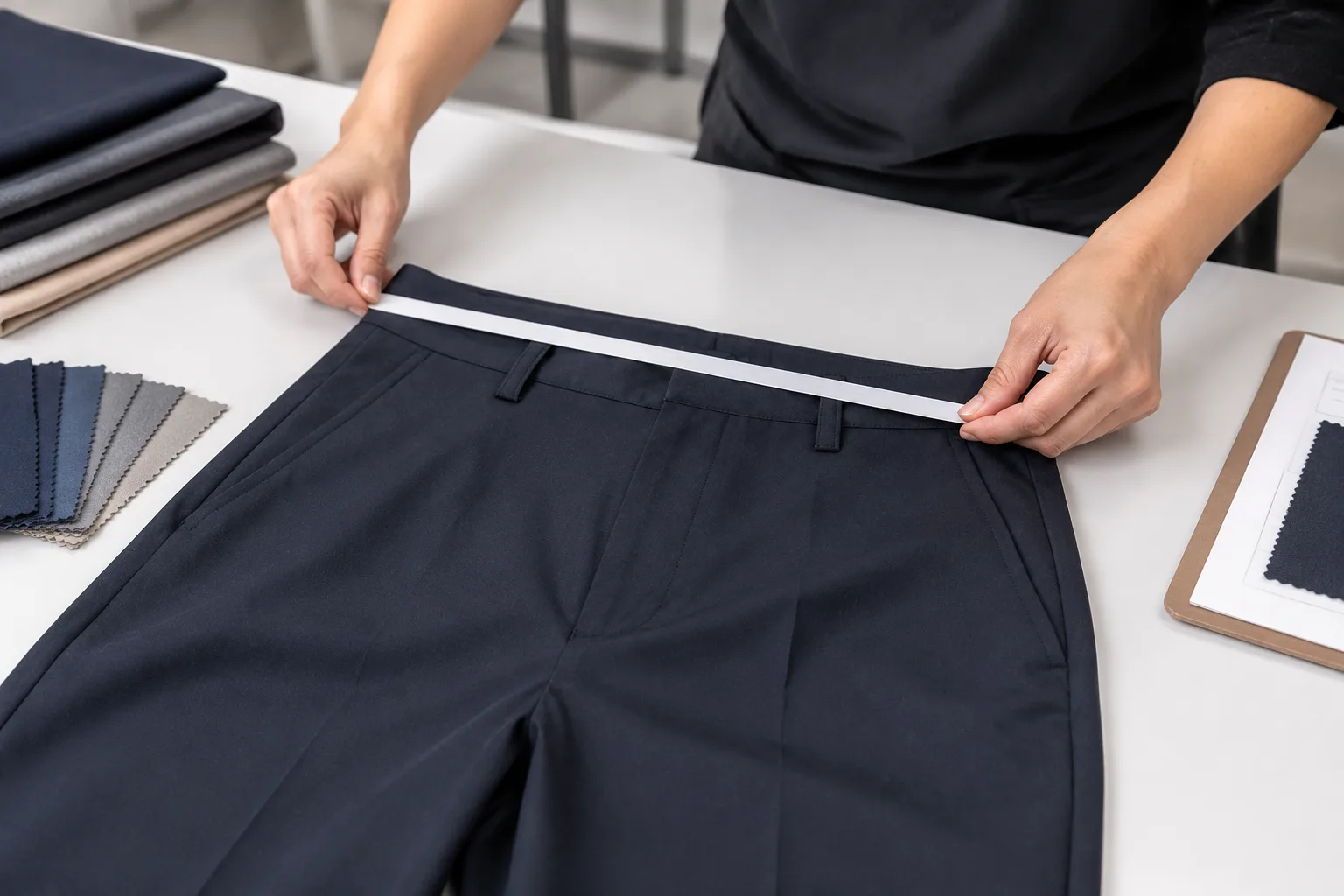
For every point of measure (POM), verify its name, location, start and end points, measuring method, unit, base size, and applicable tolerance. State whether the garment is measured flat, relaxed, or stretched, and distinguish a flat width from a circumference. A tolerance defines permitted variation; it does not correct an unsupported target measurement.
Compare the chart with the flat, intended fit, and construction. For trousers, review waist, seat, front and back rise, thigh, inseam, and overall length as a coordinated set. Waist size alone cannot establish the fit, and no single chart should be assumed suitable for every market or body type.
Make grading an explicit approval
A technical designer or assigned pattern specialist should review grade increments across the full size range rather than applying one scaling rule everywhere. The buyer or designated technical authority must approve those rules. Use measured references, documented fit assumptions, and sample measurement and fit-revision records to support corrections; preserve the technical redline showing what changed and why.
Challenge Unsupported Fabric, Finish, Performance, and Decoration Assumptions
Separate visible characteristics from material and performance claims. An image may suggest texture or silhouette; it cannot verify fiber composition, GSM, stretch recovery, durability, breathability, or water resistance. AI-generated adjectives are not material evidence.
Confirm composition, fabric weight, knit or weave structure, color reference, finish, and trim requirements against a buyer instruction or identified material reference. Where a choice remains open, label it as a sourcing proposal requiring approval rather than presenting it as a confirmed specification.
Performance language needs a defined evaluation basis. Ask for the intended use, relevant test method and target where testing is required, and supporting evidence for any claimed result. A buyer-approved reference may help define a sensory preference, but it does not prove measurable performance.
For embroidery, screen printing, heat transfer, patches, appliqué, or reflective details, specify the selected method, approved artwork, dimensions, placement reference points, and colors. Confirm compatibility with the proposed fabric before treating the decoration as settled.
Where included in the brief, verify care-label copy, branding labels, country-of-origin information, hangtags, barcodes, and packaging instructions. Have the responsible buyer reviewer confirm destination-specific requirements; do not treat AI-generated label wording as compliance evidence.
Translate Review Findings Into Sampling Cost and Budget Decisions
Once a review finding is classified, connect it to the decision it may change. A missing measurement is a specification gap; an unconfirmed fabric weight is a sourcing variable; extra panels or trims are cost drivers; a minor color preference may be a cosmetic decision. This prevents every comment from being treated as equally urgent.
Do not use an AI-generated price as a quotation. First confirm the construction, materials, decoration, labels, packaging, size range, and sample objectives. Then ask the buyer and manufacturer to evaluate the same defined brief. For OEM or ODM development, record which choices come from the buyer and which require manufacturer confirmation.
| AI assumption | Verification question | Possible sampling consequence | Budget decision | Approving owner |
|---|---|---|---|---|
| Extra body panel | Is the panel required for fit, appearance, or function? | New pattern pieces, seams, and construction review | Compare detailed and simplified constructions | Designer and technical reviewer |
| Special trim or closure | What material, size, placement, and finish are required? | Trim sourcing and attachment method may change | Confirm an approved alternative if needed | Buyer and manufacturer |
| Complex decoration | Which artwork, method, dimensions, and colors are approved? | Additional placement or compatibility review | Separate essential branding from optional detail | Brand or artwork owner |
| Custom packaging | How will goods be received, allocated, and replenished? | Different packing instructions or sample checks | Choose prepacks or open-size packing deliberately | Operations or buying owner |
Keep alternatives in the revision record. For example, compare a simpler single-panel construction with a more detailed version by listing the visual difference, unresolved technical question, sample purpose, and commercial decision required. That record gives the quotation reviewer a defined choice instead of an AI assumption presented as a fixed requirement.
Use Two Buyer Scenarios to Decide What Must Be Resolved First
The review priority changes with the buyer’s evidence, risk, and approval structure. The following are clearly hypothetical examples; they illustrate decision logic, not customer results or price expectations.
1. Startup apparel brand
Buyer situation: A startup has an AI-generated fashion flat and reference images for a new style. The document looks detailed but lacks verified measurements, fabric composition or weight, grading direction, and a clear owner for open decisions.
Available evidence: The buyer has design intent, visual references, and perhaps a physical reference sample. The sample should be separated into details to preserve, details to change, measured dimensions, and any required usage permission.
Evidence gap: The flat does not establish the POM definitions, tolerances, material specification, or size development. AI confidence cannot substitute for those inputs.
Outcome: Clarify before sampling. The buyer should approve the design priorities, while a technical or pattern specialist and the manufacturer clarify measurements, materials, and grading. Move to Go only when the sample brief identifies what the first sample must answer. Pause if the team cannot decide which visual or fit requirements are essential.
2. Uniform or teamwear buyer
Buyer situation: A uniform buyer has a clearer size range and decoration plan but has not finalized label content, wearer practicality, size allocation, or whether locations will receive prepacks or open-size packing.
Available evidence: The buyer can provide wearer profiles, decoration artwork, placement references, size ratios, receiving instructions, and an internal approval route. A reference garment may help confirm fit or construction details.
Evidence gap: The AI file may show a convincing logo placement while omitting movement needs, label responsibility, packaging instructions, or the difference between a visual size range and an approved grading rule.
Outcome: Clarify use-case requirements, decoration placement, labels, and downstream packing before the sampling handoff. Go when the designated technical reviewer approves the measurements and the operations owner approves receiving instructions. Pause when artwork, size allocation, or wearer requirements remain unresolved.
In both cases, assign each open item to a buyer, designer, technical reviewer, artwork owner, operations lead, or manufacturer. A visually accurate document is commercially incomplete until its measurable requirements and responsibility assignments are clear.
Approve the Sampling Revision With a Version-Controlled Sign-Off
Finish the review with one dated technical redline, then issue a clean revision that incorporates agreed changes. Do not leave the active specification spread across comments, chat messages, image annotations, and multiple file versions.
Final sampling handoff checklist
- Approved flats and construction details match the BOM.
- POM definitions, measurement methods, tolerances, size range, and grading direction are recorded.
- Materials, trims, decoration, labels, packaging, and reference-sample changes are identified.
- Each open item has an owner and a Pass, Revise, or Hold status.
- The sample objective states whether the sample is checking fit, construction, decoration placement, material suitability, or another defined question.
- File names, revision date, approver names, reference-sample status, and feedback format are listed.
Assign sign-off by responsibility: the design owner approves design intent; the technical reviewer approves measurements and grading; the artwork owner approves decoration; the operations or buying owner approves commercial priorities and packing; the designated sampling approver releases the handoff.
An approved sample and reviewed tech pack support the next development decision, but they do not automatically replace order-specific quality, compliance, inspection, or acceptance agreements. Any inspection arrangement, including an AQL-based plan, must be agreed for the specific order and cannot repair unclear product specifications.
Use the clean revision as the sole active sampling instruction. Record every later change in a sample revision log, including the reason, affected files, decision owner, and whether another sample review is required.
For a project review, send the current AI tech pack, garment specifications, measurements and tolerances, BOM, fabric and trim details, decoration artwork and placement, size range, reference sample information, packaging requirements, target quantity, and delivery destination. Include the revision date and identify which decisions are already approved. Share these project inputs with Ninghow through its contact page for confirmation of the appropriate development scope.
Frequently Asked Questions
Can AI infer garment measurements from a photo?
AI can suggest approximate proportions from a photo, but a photo does not reliably establish production measurements, POM definitions, tolerances, grading, fabric behavior, or garment construction. Treat image-derived measurements as proposed for review. Confirm them through a measurement method, reference sample, technical assessment, or other project-specific evidence before sampling.
Who should approve grading rules in an AI-generated tech pack?
Technical or pattern specialists should review grading rules, while the buyer or designated technical authority approves the final direction. The approver should confirm the size range, base size, grade increments, and intended wearer profile. A manufacturer can clarify development implications, but responsibility should be recorded rather than assumed from the AI document.
Is an AI-generated tech pack production-ready?
No. An AI-generated tech pack is a draft until qualified review resolves its measurements, construction, materials, decoration, labeling, packaging, and approval ownership. Even an approved sample and revised tech pack do not replace order-specific quality, compliance, inspection, or acceptance agreements. Production release requires the responsible parties to confirm the active specification.
What should be checked first in an AI tech pack before sampling?
Start with contradictions between the flats, BOM, construction notes, and measurements. Then verify POM definitions, tolerances, grading, materials, decoration, labels, packaging, and open-item ownership. Prioritize anything that could change pattern work, sourcing, sample objectives, or budget. Use a dated redline and Pass, Revise, or Hold status.
How can an AI tech pack affect sampling cost and budget?
An AI tech pack can affect budget when it introduces unpriced panels, trims, decoration, packaging, fit rounds, or performance-related requirements. Classify each issue as a specification gap, sampling variable, cost driver, or cosmetic preference. Confirm the revised brief with the buyer and manufacturer before treating any commercial evaluation as meaningful.
Should a reference sample be reviewed alongside an AI-generated tech pack?
Yes, when a reference sample is available and its use is authorized. Review it alongside the AI tech pack, separating details to preserve, details to change, measured dimensions, and unresolved requirements. A reference sample can add useful physical evidence, but it does not automatically define every measurement, material, grading rule, or production obligation.