





A useful apparel manufacturing article cannot be planned from a keyword alone. Before deciding on a title, outline, or production angle, the brief should explain who the reader is, what garment they are developing, which sourcing problem they need to solve, and what action they may take after reading. Without that information, an article can mention custom clothing, private label apparel, and OEM production without giving a buyer a practical decision path.
If the missing direction relates to a branded sweatshirt or seasonal collection, custom hoodie manufacturing options for brand development can provide a useful starting point. A manufacturer can then connect fabric selection, fit refinement, logo application, private label details, sampling, packaging, and bulk production planning to the reader’s actual project rather than treating every apparel request as the same.
Why the Topic, Core Keyword, and Content Direction Must Be Defined First
The first planning decision is not which keyword to repeat. It is what the article must help a buyer understand or decide. A founder comparing private label suppliers needs different information from a school ordering teamwear, while a product developer preparing an OEM tech pack needs more technical depth than a first-time retailer.
A clear brief prevents three common problems. The article may target the wrong search intent, describe the wrong garment category, or promise production guidance without explaining the specifications needed for a quote. Each problem reduces usefulness and can create poor expectations between a buyer and a manufacturer.
We recommend defining the article through five connected questions:
- Who is the intended reader and what stage of the buying process are they in?
- What garment or product family is being discussed?
- What manufacturing or sourcing problem should the article solve?
- Which specifications, customization methods, and production stages matter?
- What should the reader be able to evaluate, prepare, or request after reading?
Key takeaway: A strong article brief describes a buyer decision before it describes a keyword. The keyword should help people find the article, while the decision gives the article its value.
Identify the Primary Search Intent Before Choosing an Article Angle

Search intent determines the structure and depth of the article. For an informational guide, the reader usually wants to understand how to frame a project, compare manufacturing routes, or prepare better information before approaching suppliers. The content should answer those questions directly instead of turning every section into a sales message.
| Search intent | Typical reader question | Useful article direction |
|---|---|---|
| Informational | What information is needed before requesting apparel production? | Explain the planning framework, terminology, and preparation steps. |
| Commercial | What can a manufacturer provide for my garment project? | Explain capabilities, customization choices, sampling, MOQ, and production planning. |
| Comparison | Should I use OEM, ODM, private label, or a ready pattern? | Compare responsibilities, development control, cost factors, and speed. |
| Decision-making | Which supplier or production route fits my order? | Provide evaluation criteria, risk checks, and a buyer checklist. |
One article can contain more than one intent, but one intent should lead. Since this topic concerns missing input, the primary direction should be informational and planning-focused. Commercial details can support the explanation, but they should not replace the central task of helping the reader define a specific apparel manufacturing brief.
The intended action may be modest. A reader may need to write a complete product brief, identify missing technical data, prepare questions for suppliers, or decide whether an OEM, ODM, private label, or low-MOQ route is appropriate. Defining that action helps determine which sections deserve the most space.
Define the Target Reader and Their Buying Stage
The reader profile affects vocabulary, examples, and the level of manufacturing detail. A brand founder may need help understanding GSM, grading, labels, and minimum order quantities. A sourcing manager may already know those terms and instead need a clear framework for comparing factory capability, lead time, quality controls, and commercial risk.
Use the following reader groups as starting points, then choose one primary audience for the article:
- Brand founder: needs product positioning, private label development, manageable MOQ, samples, and a realistic launch plan.
- Sourcing manager: needs supplier evaluation, cost drivers, capacity, documentation, quality checkpoints, and delivery planning.
- Retailer or distributor: needs repeatable sizing, commercial colors, packaging, margin protection, and bulk consistency.
- Team, club, or school buyer: needs durability, size coverage, decoration methods, delivery dates, and reorder practicality.
- Product developer: needs fabric construction, pattern details, measurement specifications, grading, trims, and approval control.
Buying stage matters as well. Early-stage readers need terminology and direction. Readers with a defined design need supplier questions, tech pack requirements, and sampling guidance. Buyers ready for production need purchase specifications, tolerances, inspection standards, packaging instructions, and a confirmed production schedule.
At Ninghow, we see that the most productive manufacturing conversations begin when the buyer’s audience, sales channel, order purpose, and intended delivery market are stated clearly. Those details influence fabric performance, labeling, packaging, size range, decoration, and production planning.
Specify the Garment Category and Use Scenario
An apparel article becomes much more useful when it names the garment category and use scenario. “Custom clothing” is too broad to guide a manufacturer. A heavyweight streetwear hoodie, a lightweight team training top, a golf polo, and a school uniform shirt may all require different fabrics, construction choices, decoration methods, and approval checks.
The use scenario should explain how and where the garment will be worn. Consider climate, activity level, expected wash frequency, layering, movement, retail positioning, and whether the garment is a fashion product, uniform, promotional item, or performance product.
| Garment direction | Specifications to clarify | Common production questions |
|---|---|---|
| Hoodie or sweatshirt | Fleece type, GSM, brushed or unbrushed interior, rib structure, hood shape, decoration area | Should it feel structured, soft, oversized, lightweight, or suitable for layering? |
| T-shirt or training top | Fiber blend, stretch, moisture management needs, neckline, body length, seam construction | Will the garment be used for everyday wear, sport, uniforms, or promotional distribution? |
| Polo shirt | Pique or jersey construction, collar, placket, colorfastness, breathability, logo placement | Does the product need a polished retail look or durable workwear performance? |
| Jacket or outer layer | Shell fabric, lining, insulation, closures, pockets, water resistance, seam details | What weather protection and packing requirements must the garment meet? |
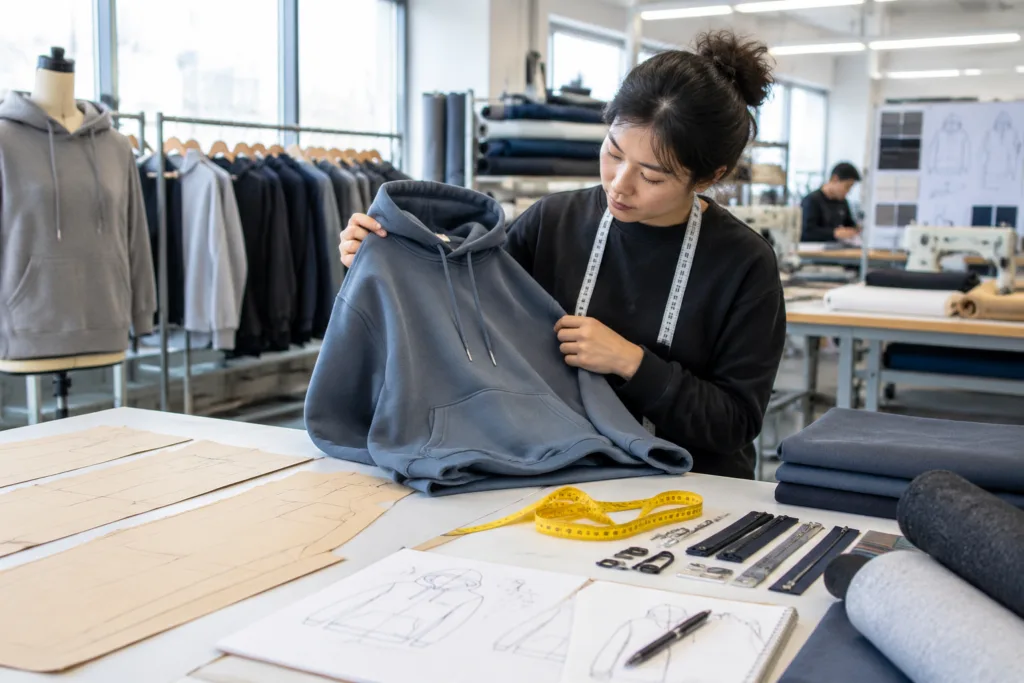
Application-specific details should appear in the article outline, not be added as generic examples at the end. If the topic is a hoodie, the article should address hood dimensions, kangaroo pocket construction, rib recovery, drawcord decisions, and the way embroidery or large prints affect the front panel.
Clarify the Main Apparel Manufacturing Problem to Solve
The article should solve one main problem and several supporting problems. Possible central problems include choosing a suitable production model, preparing a complete brief, reducing sample revisions, controlling quality across sizes, selecting decoration methods, or deciding whether a low-MOQ order is practical.
A useful problem statement is specific enough to guide the content. For example: “Help an apparel startup prepare a private label hoodie brief that a manufacturer can quote accurately.” This is stronger than “Write about hoodies” because it identifies the reader, garment, commercial stage, and desired result.
Manufacturing problems often connect to one another. An unclear fit can create repeated samples, which affects lead time and cost. A late logo decision can affect the decoration method and production sequence. An undefined destination market can create problems with fiber disclosure, country-of-origin information, or other product requirements.
For U.S.-bound products, the article can point readers toward textile and apparel labeling requirements when explaining why the destination market and label information should be identified before finalizing trims and private label deliverables. The article should still advise buyers to confirm requirements for every market in which the product will be sold.
Select the Core Keyword and Related Semantic Terms
The primary keyword for this article is “apparel manufacturing.” It is broad, so the content must establish a more specific context early. The supporting terms should reflect the planning problem and the buyer’s likely language rather than becoming a disconnected list of phrases.
Useful semantic terms may include custom clothing manufacturing, private label apparel, OEM apparel production, ODM garment development, apparel sourcing, clothing manufacturer, garment sampling, tech pack, pattern development, low MOQ clothing manufacturing, apparel quality control, production lead time, fabric GSM, embroidery, screen printing, labels, trims, packaging, and bulk garment production.
Keyword selection should follow the article’s decisions. If the reader is preparing a hoodie brief, include hoodie manufacturing and custom hoodie development. If the reader is comparing production models, include OEM versus ODM apparel. If the main concern is a small launch order, include low MOQ, fabric availability, trim sourcing, and repeat-order planning.
A practical keyword map can assign one topic to each major section:
- Introduction: apparel manufacturing and content planning.
- Reader and use scenario: custom clothing manufacturing and garment development.
- Production model: OEM, ODM, and private label apparel.
- Technical brief: fabric GSM, fit, sizing, construction, and tech pack.
- Commercial planning: MOQ, lead time, cost drivers, and bulk production.
- Risk control: apparel sampling, quality control, and supplier evaluation.
Determine Whether Fabric, GSM, Fit, and Construction Need Coverage
Technical depth should match the garment and reader. A general planning article does not need a full textile engineering lesson, but it should tell the buyer which specifications must be defined before a factory can make a reliable recommendation or quotation.
Fabric composition identifies the fiber content, while construction describes how the fabric is made. GSM describes mass per unit area and can influence hand feel, opacity, warmth, drape, and perceived quality. It should not be treated as a complete description of performance: two fabrics with similar GSM can feel different because of yarn, knit structure, finishing, fiber blend, and treatment.
When a buyer uses terms such as lightweight, premium, soft, or heavyweight, we translate those descriptions into measurable or sample-based requirements. A clearer brief may specify composition, fabric construction, target GSM, color, finish, stretch expectation, shrinkage tolerance, and acceptable hand feel. For technically sensitive projects, the buyer should also identify the intended test method and tolerance. The fabric GSM and mass-per-unit-area testing reference can help explain why fabric weight should be treated as a measurable specification rather than a casual description.
Fit requires the same discipline. A size chart should identify key points of measure, body length, chest or waist width, shoulder or sleeve dimensions, and tolerances. The brief should also state whether the fit is standard, relaxed, slim, oversized, athletic, or designed for layering.
Construction details should be prioritized according to use. Relevant points may include seam type, stitch density, binding, bartacks, pocket reinforcement, rib recovery, zipper quality, lining, interlining, drawcord safety, and wash or finish requirements. Including every possible detail can overwhelm an early brief, so the article should distinguish essential specifications from optional refinements.
Decide Which Customization Methods Belong in the Article
Customization should be selected according to artwork, fabric, quantity, use, appearance, and durability. The article should not list printing and embroidery as interchangeable services. Each method changes the sample process, placement control, cost, production timing, and garment suitability.
| Method | Useful for | Planning points |
|---|---|---|
| Screen printing | Bold graphics and repeatable artwork on suitable fabric surfaces | Color count, print size, registration, curing, and wash performance. |
| Heat transfer | Detailed logos, names, numbers, and smaller production runs | Artwork complexity, film or transfer type, placement, and heat sensitivity. |
| Embroidery | Polos, caps, uniforms, workwear, and raised premium branding | Stitch count, backing, small lettering, fabric weight, and distortion risk. |
| Sublimation | Selected polyester performance garments with all-over or detailed graphics | Fiber content, base color, pattern files, and color expectations. |
Private label development may also include woven labels, printed care labels, hangtags, branded packaging, size stickers, polybags, cartons, and inserts. These items should be confirmed before bulk production because artwork approval, trim sourcing, and packaging assembly can affect both MOQ and schedule.
A strong article angle explains what the buyer must provide: vector artwork where available, logo dimensions, placement measurements, color references, label content, packaging preferences, and any required size or care information. If the artwork is not ready, the brief should say whether the manufacturer is expected to assist with development or only produce from approved files.
Choose the Appropriate OEM, ODM, Private Label, or Low-MOQ Angle
OEM, ODM, and private label describe different levels of product development responsibility. OEM usually means the buyer supplies a defined design or technical package for production. ODM may involve adapting an existing manufacturer capability or design direction. Private label generally means producing a garment under the buyer’s brand, with agreed labels, packaging, and product specifications.
Low MOQ should be presented as a planning condition, not a universal promise. The practical minimum can depend on fabric stock, dyeing requirements, color count, pattern complexity, trims, decoration, packaging, and whether the supplier must develop a new style. Buyers exploring low MOQ clothing manufacturing options should ask whether the stated minimum applies to each color, size breakdown, style, or total order.
A useful comparison section can explain the trade-offs:
- Using available fabric and existing construction details may reduce development time and make a smaller order more practical.
- Custom-dyed fabric, special trims, complex panels, and new patterns may require higher commitments or longer preparation.
- Private label trims can be added to a proven base garment, but the buyer should still approve label placement, packaging, and final measurements.
- A low first order should be planned with future repeat orders in mind, including fabric continuity, color matching, and size demand.
Include Sampling, Tech Pack Readiness, and Approval Stages
Sampling is where an idea becomes a measurable garment. A strong article should explain that the first sample is not automatically a final production standard. It is an opportunity to evaluate proportions, fabric behavior, construction, decoration, trims, and overall suitability before bulk commitment.
Before sampling, the buyer should prepare as much information as possible:
- Reference images, sketches, or an existing garment for comparison.
- Fabric composition, construction, target GSM, color, and finish preferences.
- Measurement chart, size range, fit description, and grading expectations.
- Artwork files, logo placement, decoration method, labels, and packaging requirements.
- Target quantity, delivery market, required date, and expected reorder potential.
The apparel sampling process should be described as a controlled sequence of review and approval. Depending on the product, this may include a development sample, fit sample, size set, decoration sample, pre-production sample, and final approval. Not every project needs every stage, but the article should make clear who approves each stage and which changes are still allowed.
Pattern development and grading deserve specific attention. A garment that fits well in one size can still fail in larger or smaller sizes if grading is not reviewed carefully. Buyers should approve measurements with tolerances, not rely only on a visual photograph. Comments should identify the exact point of measure and the desired correction so that the factory can update the pattern consistently.
Address MOQ, Lead Time, Cost Drivers, and Bulk Planning
A production article should explain what affects the commercial plan before presenting any timeline or quantity expectation. MOQ, lead time, and price are connected, but they are not interchangeable. A lower quantity may reduce total commitment while increasing the unit cost, especially when development, trims, setup, and packaging are spread across fewer pieces.
| Cost or timing driver | Why it matters | What the brief should state |
|---|---|---|
| Fabric | Composition, GSM, availability, dyeing, and finishing influence price and schedule. | Target fabric, color, quantity, stock flexibility, and approved alternatives. |
| Pattern and construction | Panels, pockets, special seams, and new blocks increase development work. | Reference style, technical drawings, measurements, and construction priorities. |
| Decoration | Artwork, method, placement, and quantity affect setup and production sequence. | Logo files, dimensions, colors, technique, and approval standard. |
| Trims and packaging | Custom labels, hangtags, bags, and cartons require sourcing and coordination. | Branding content, materials, dimensions, packing method, and carton details. |
| Inspection and rework | Unclear standards can create disputes or late corrections. | Measurement tolerances, appearance standards, defect limits, and inspection stage. |
The article should distinguish development time, material preparation, production time, finishing, inspection, and shipping. The apparel production timeline planning resource is relevant when explaining why a delivery date should be built backward from the required arrival date, with approval time and contingency included.
Buyers should also confirm whether the quoted lead time starts after deposit, after fabric approval, after trim approval, or after the pre-production sample. This single clarification prevents many misunderstandings. A manufacturer cannot responsibly confirm bulk timing while the fabric, artwork, size chart, or packaging specifications remain open.
Add Quality Control and Supplier Evaluation Guidance
Quality control should be written as a series of checkpoints rather than a final visual inspection only. The purpose is to prevent defects from moving forward and to create a shared standard between buyer and manufacturer.
Relevant checkpoints may include incoming fabric inspection, color and GSM confirmation, pattern review, size-set measurement, trim verification, decoration approval, inline sewing checks, finished garment measurement, appearance inspection, packing review, and pre-shipment inspection. The exact process should reflect the garment’s risk profile and order size.
Buyers considering supplier capability should ask practical questions:
- Can the supplier explain the fabric, pattern, and construction decisions behind the quotation?
- How are sample comments recorded and carried into bulk production?
- Which measurements and tolerances will be checked during production?
- How are print, embroidery, labels, color, and packaging approved?
- What happens if fabric or trims become unavailable before bulk production?
- Can the supplier support repeat orders with consistent specifications?
Buyers can review apparel quality control support when building this part of an article, but the content should remain specific to the proposed garment. A hoodie, polo, uniform, and performance top do not have identical risk points. A useful supplier evaluation section explains what will be checked, when it will be checked, and what evidence the buyer receives.
Define External Sources, Standards, and Technical Evidence
External references should strengthen a focused article rather than make it look academic. Use them where a buyer needs reliable information about labeling, product safety, testing, or technical definitions. The article should explain the practical implication in its own words and then link to the relevant source.
The target market should be identified before the article discusses compliance. Requirements can vary by country, product category, fiber content, decoration, and intended use. For example, a brief may need to account for fiber disclosure, country-of-origin information, manufacturer or dealer identification, care information, or product-safety considerations. The article should avoid presenting one market’s requirements as universal.
Product category and material structure can also affect technical review. For U.S. products, buyers may need to consider apparel flammability and product-safety requirements when the fabric, surface characteristics, and intended use make those requirements relevant. A manufacturer-informed article should encourage early confirmation rather than waiting until after bulk production.
When selecting external sources, prioritize government agencies, recognized standards organizations, and official technical guidance. Avoid unsupported claims about certifications, test results, sustainability, or performance. If a source does not directly help the reader make a specification or compliance decision, it probably does not belong in the article.
Final Input Checklist for a Specific Ninghow Article Plan
Before generating the final article plan, collect the information below. If an item is unknown, mark it as undecided rather than silently making an assumption. Clear unknowns can be addressed as questions in the article or during supplier communication.
- Article purpose and primary search intent.
- Primary reader, buying stage, and likely commercial decision.
- Garment category, use scenario, climate, activity level, and sales channel.
- Primary manufacturing problem the article must solve.
- Primary keyword and a short list of natural semantic terms.
- Fabric composition, construction, target GSM, hand feel, stretch, and performance needs.
- Fit direction, size range, measurement chart, grading, and tolerances.
- Construction details that affect comfort, durability, appearance, or cost.
- Decoration method, artwork status, placement, labels, trims, and packaging.
- OEM, ODM, private label, custom development, or low-MOQ angle.
- Sample stages, tech pack readiness, approval responsibilities, and revision limits.
- Target quantity, size breakdown, color count, delivery date, and reorder expectations.
- Cost drivers, material alternatives, MOQ constraints, and lead time assumptions.
- Quality checkpoints, inspection expectations, and supplier evaluation questions.
- Destination market, required sources, standards, regulations, and technical evidence.
Once these inputs are available, the article can be specific without becoming overly narrow. It can teach a founder how to prepare a private label brief, help a sourcing manager compare production routes, or guide a team buyer through custom garment requirements. The important point is that the structure should follow the real buyer decision.
Conclusion: Turn Missing Direction Into a Useful Manufacturing Brief

When the topic, keyword, and content direction are missing, the right response is to define the decision before drafting the article. Start with the reader, garment, use scenario, and sourcing problem. Then add the technical, customization, commercial, compliance, and quality details that make the guidance actionable.
For Ninghow, a well-defined apparel manufacturing article should reflect how real product development works: fabric and fit affect construction, customization affects sampling, labels and packaging affect preparation, MOQ affects material choices, and approval discipline affects bulk consistency. A clear input brief allows the final article to educate buyers while setting practical expectations for OEM, ODM, private label, and custom clothing production.
Key takeaway: The best article plan is not the one with the most keywords. It is the one that gives a defined buyer enough information to prepare a realistic product brief, compare manufacturing options, and reduce avoidable production risk.
Frequently Asked Questions
What information should be defined before writing an apparel manufacturing article?
Define the intended reader, garment category, use scenario, search intent, sourcing problem, customization needs, target market, and expected reader action before writing. Then determine which technical topics, such as fabric GSM, fit, sizing, sampling, MOQ, lead time, and quality control, are genuinely relevant to that project.
How specific should the garment category be in the article brief?
The category should be specific enough to guide production decisions, such as hoodie, polo shirt, training top, uniform shirt, or jacket. Include the use scenario because the same garment type can require different fabric, construction, decoration, durability, and packaging choices depending on whether it is intended for retail, sport, work, school, or promotional use.
Should a planning article explain OEM, ODM, private label, and low MOQ?
It should explain those routes when the reader needs to choose between them. OEM, ODM, private label, and low MOQ involve different levels of design control, material commitment, development work, customization, and production planning, so the article should connect each option to a clear buyer situation rather than presenting the terms as interchangeable.
Why are fabric GSM and fit specifications important in an apparel brief?
Fabric GSM and fit specifications convert vague descriptions into information that can be sampled and checked. GSM helps define fabric weight, while composition, construction, finish, measurements, grading, and tolerances explain how the garment should feel, perform, and fit across the size range.
When should sampling and tech pack readiness be included?
Include sampling and tech pack guidance whenever the article concerns custom development, private label production, OEM manufacturing, or a product with important fit and construction requirements. These topics show buyers what must be approved before bulk production and help reduce revisions caused by incomplete measurements, artwork, fabric, or trim information.
How can a content brief reduce apparel production risk?
A content brief reduces risk by making assumptions visible before the article or production discussion begins. When the buyer, garment, materials, customization, destination market, quantity, delivery date, approval stages, and quality checkpoints are defined, the manufacturer can identify missing information earlier and the buyer can compare supplier responses more accurately.