

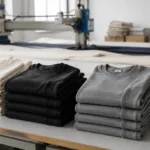



Custom clothing manufacturing turns an idea into a repeatable garment specification, approved sample, and controlled bulk order. It is suitable for brands, startups, teams, retailers, schools, and organizations that need more control over fabric, fit, branding, and packaging than ready-made wholesale apparel can provide. The process works best when buyers make product decisions early, document them clearly, and treat sampling as a technical approval stage rather than a formality.
If your project centers on fleece apparel, custom hoodie manufacturing support can help translate a concept into workable fabric, fit, print, embroidery, label, and packaging specifications. At Ninghow, we support buyers through material selection, sample refinement, private label details, MOQ planning, and bulk-production preparation so that the final hoodie is aligned with its intended customer and price position.
What Is Included in Custom Clothing Manufacturing?
Custom clothing manufacturing is the coordinated development and production of garments made to a buyer’s specifications. Those specifications may include a new pattern, a modified existing silhouette, selected fabric, custom color, artwork, branding, trims, labels, packaging, and size range.
The level of customization should match the commercial objective. A startup testing one core T-shirt may need a proven base pattern and stock fabric, while an established sportswear brand may require proprietary panels, performance fabric, graded measurements, and detailed testing expectations.
| Production route | What changes | Best suited to |
|---|---|---|
| Ready-made wholesale | Usually decoration only | Fast events, uniforms, simple resale |
| Private label | Labels, packaging, selected colors or decoration | Brands seeking a lower-risk launch |
| OEM production | Buyer supplies product specification and design direction | Brands with established product requirements |
| ODM production | Manufacturer assists with existing designs and development choices | Buyers needing product-development guidance |
| Fully custom development | Pattern, materials, construction, and branding can all be developed | Differentiated products and scalable collections |
Key takeaway: The right route is not the one with the most customization. It is the one that provides enough product differentiation without creating unnecessary sampling cost, MOQ pressure, or production risk.
Define the Product Before You Request a Quote
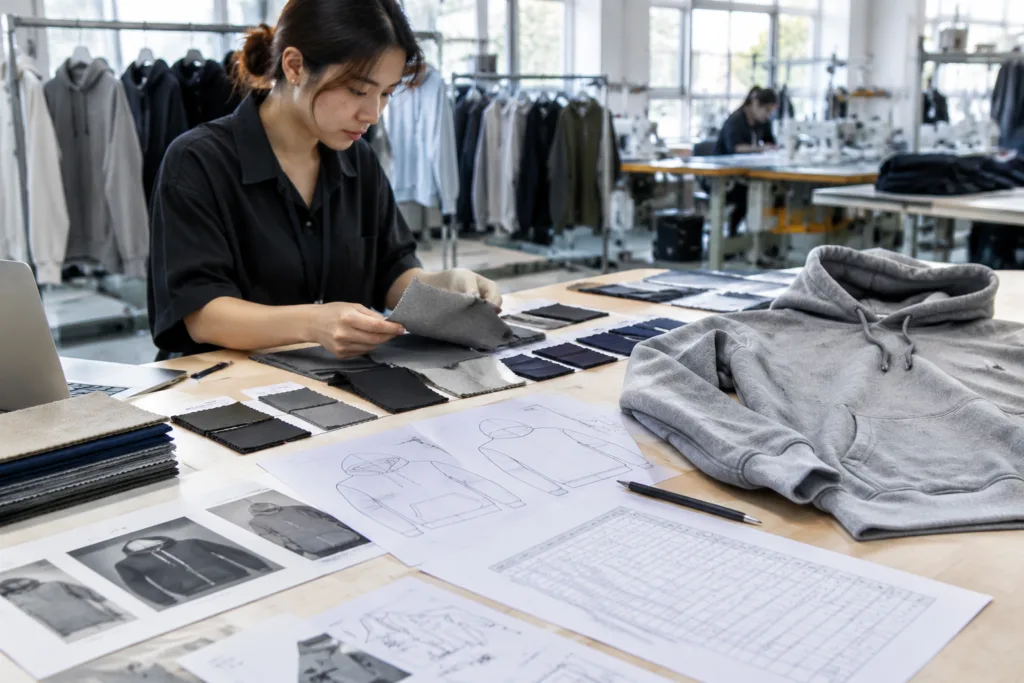
A manufacturer can price and develop more accurately when the intended garment is clear. Before requesting quotations, define the category, target wearer, retail or selling price range, use scenario, and features that cannot be compromised.
For example, a heavyweight streetwear sweatshirt, a golf polo, and a team training jersey may all use knit fabric, but they demand different hand feel, stretch, moisture management, construction, and decoration choices. Stating only “a premium top” leaves too much room for interpretation.
Build a product brief that answers practical questions
- What garment category and target customer are you producing for?
- Where and how will the garment be worn: daily use, training, workwear, travel, or retail fashion?
- What fit is expected: slim, regular, relaxed, oversized, or unisex?
- Which features are essential, such as pockets, zippers, lining, reflective details, or moisture management?
- What is the target order quantity by color and size?
- What price level must the product achieve after freight, duties, and selling costs?
A clear brief also helps identify whether stock materials are sensible or whether custom-dyed fabric is justified. Stock fabric can simplify early orders; custom fabric provides more control but normally requires larger commitments and more time.
How to Prepare a Tech Pack and Fit Specification
A tech pack is the working document that reduces assumption between buyer and factory. It does not need to be elaborate at the first discussion, but it should identify the garment, visual references, materials, measurements, artwork placement, and construction details that matter.
We recommend including front and back flats, a point-of-measurement chart, fabric composition and target GSM, color references, logo files, trim details, label artwork, and packaging instructions. Reference photos are helpful, but they should support rather than replace measurable specifications.
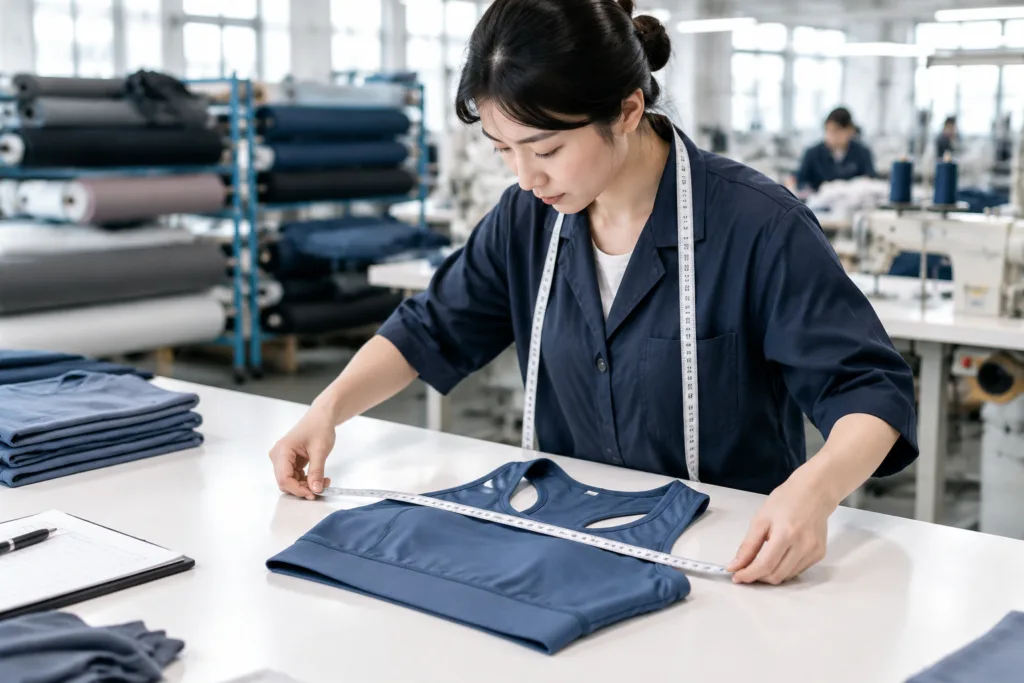
Fit requires the same discipline. Confirm the base size, body measurements, finished garment measurements, allowed tolerance, and grading rules for each additional size. A pattern that fits a medium sample can still perform poorly across the full size range if grading has not been reviewed.
Choose Fabric by Use, Hand Feel, and Cost Position
Fabric is usually the largest material decision because it affects comfort, durability, drape, decoration performance, and cost. Composition tells only part of the story; knit or weave construction, yarn quality, weight, finishing, and shrinkage behavior matter just as much.
| Fabric direction | Typical use | Buyer checks |
|---|---|---|
| 100% cotton jersey | T-shirts, casual tops | Softness, shrinkage, opacity, pilling |
| Cotton-poly fleece | Hoodies and sweatshirts | Brushed back, weight, colorfastness, recovery |
| Polyester interlock | Teamwear and activewear | Wicking, snag resistance, sublimation suitability |
| Cotton-elastane pique | Polos and smart casualwear | Stretch recovery, collar stability, surface texture |
| Nylon-spandex knit or woven | Performance leggings, shorts, jackets | Stretch, opacity, abrasion resistance, seam behavior |
GSM, or grams per square metre, indicates fabric weight but is not a universal quality grade. A 180 GSM cotton jersey can feel substantial or thin depending on yarn, knit density, finishing, and color. Ask to handle swatches and compare actual wash behavior rather than approving a fabric solely by its GSM number.
For performance garments, test the fabric in the construction it will use. Stretch fabrics may require different seam types, needle selection, and stitch density than stable cotton knits. A decoration that looks excellent on a flat panel can distort when the garment stretches on the body.
Plan Branding, Decoration, and Private Label Details Early
Decoration choices affect visual impact, lead time, and unit cost. Screen printing is efficient for larger runs with bold artwork, embroidery gives texture and durability on suitable fabric, heat transfer handles detailed multicolor graphics, and sublimation is effective for polyester garments where all-over color and graphics are needed.
For brands building an identifiable retail product, private label clothing production should be planned alongside the garment rather than added after sample approval. Main labels, size labels, care labels, hangtags, polybags, carton marks, and folding instructions all need approved artwork and placement guidance.
| Method | Strong use case | Planning concern |
|---|---|---|
| Embroidery | Polos, caps, fleece, uniforms | Backing, stitch density, fabric puckering |
| Screen printing | T-shirts, hoodies, large graphics | Color count, print feel, artwork separation |
| Heat transfer | Names, numbers, detailed small runs | Adhesion, washing, placement consistency |
| Sublimation | Polyester teamwear and activewear | Fabric composition and color control |
| Woven labels | Brand identity and premium detailing | Fold type, edge finish, sewing position |
Care content and country-of-origin requirements vary by selling market. Buyers should confirm the applicable labeling rules before production and make sure the label artwork is reviewed as carefully as the outer branding.
Use Sampling to Resolve Risk Before Bulk Production
A sample should prove that the specification can be made consistently, not simply demonstrate that a garment looks close to the concept. The first prototype may reveal pattern, fabric, color, trim, or decoration issues. That is useful information when it is documented and resolved before bulk materials are committed.
A structured apparel sampling and approval process gives buyers a reliable way to review each iteration. For a more complex product, development may move from prototype to fit sample, pre-production sample, and finally a sealed reference that the production team can follow.
Review every sample against the same checkpoints
- Measure key points against the approved size specification.
- Try the garment on an appropriate fit model, not only on a hanger.
- Check collar shape, shoulder balance, seam alignment, pocket position, and hem level.
- Compare color and fabric hand feel with the approved swatch.
- Inspect artwork size, location, edge quality, and wash performance where relevant.
- Record every change in writing, with photos and updated files where necessary.
Do not approve a sample with unresolved comments in an email thread. Consolidate revisions into one version-controlled approval document. This protects both sides from building bulk production around conflicting instructions.
How MOQ and Lead Time Change the Production Plan
MOQ is not one fixed number for every garment. It can depend on fabric availability, dyeing requirement, color count, trim sourcing, print method, pattern complexity, and production-line efficiency. A stock fabric and standard color may support a smaller order than custom-dyed fabric with specialized branded components.
Buyers exploring low MOQ clothing manufacturing options should distinguish between a low garment quantity and a fully custom material program. Smaller runs are often more practical when designs use available fabrics, limited colorways, common trims, and streamlined decoration.
| Stage | What can extend timing | How buyers can reduce delay |
|---|---|---|
| Development | Incomplete specs or repeated fit changes | Provide clear tech packs and consolidated comments |
| Material sourcing | Custom dyeing or unavailable trims | Approve alternates and source early |
| Sampling | Late artwork or untested construction | Confirm all logo files and sample priorities |
| Bulk production | Many colors, complex decoration, late approvals | Lock the pre-production sample before cutting |
| Finishing and shipment | Rework, packaging changes, booking constraints | Confirm packing details and freight plan early |
Lead time should be discussed as a schedule with dependencies, not as a single promise. Material booking, sample approval, production slot availability, inspection, and freight each have separate timing. An earlier purchase order does not help if the final artwork or label files arrive late.
Build Quality Control into the Process, Not the Final Day
Reliable quality control begins before sewing. Fabric should be checked for shade variation, defects, width, weight, and relevant performance concerns; cutting should follow approved markers and grain direction; sewing should be monitored for stitch balance, skipped stitches, seam puckering, and measurement accuracy.
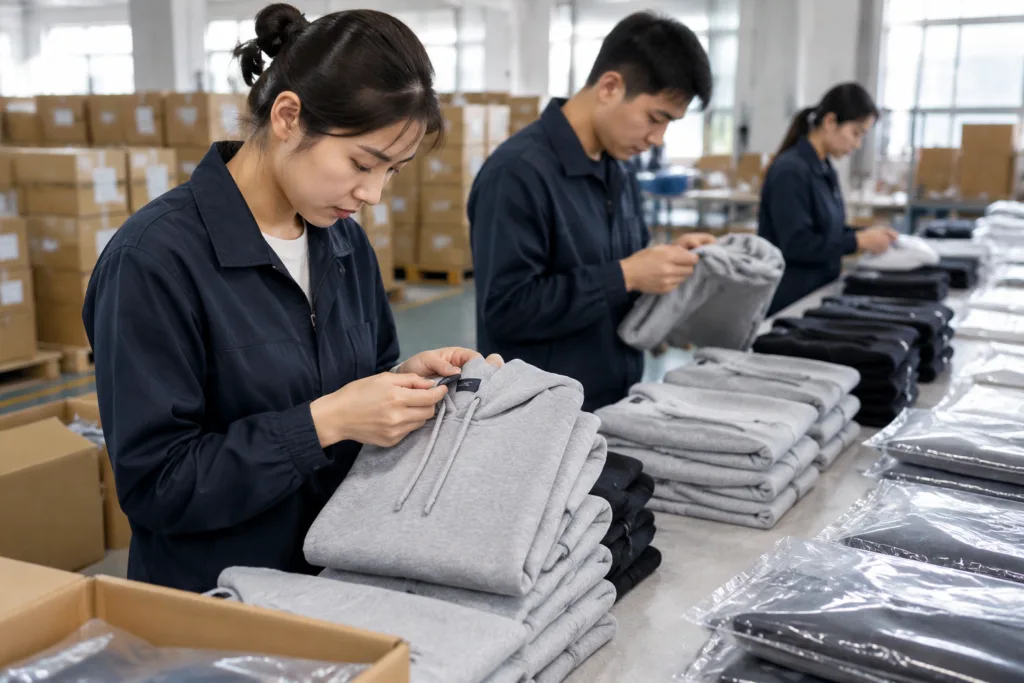
During finishing, teams should verify pressing, thread trimming, decoration appearance, label attachment, folding, packaging, and carton assortment. Final inspection is important, but it cannot efficiently correct systemic issues created during earlier stages. Our apparel quality control procedures focus on checkpoints that make defects visible while they are still manageable.
From our manufacturing perspective, the strongest quality reference is an approved pre-production sample paired with a clear specification sheet. It gives fabric, cutting, sewing, decoration, and finishing teams one shared standard instead of relying on verbal interpretation.
Compare Suppliers on Capability, Communication, and Risk Control
A low quotation is only useful if the supplier can reproduce the approved product, communicate changes promptly, and maintain quality as quantity grows. Compare factories on the categories they actually make, their material sourcing approach, sample process, capacity, inspection practices, and ability to explain cost changes.
When reviewing ethical sourcing claims, ask for specific information about the production site, audit scope, assessment date, and corrective-action process rather than relying on broad statements. The Better Work transparency framework illustrates why factory compliance assessment and production-site information should be considered as part of supplier due diligence.
At Ninghow, we find that early communication is most productive when buyers share their target market, quantity range, expected delivery window, and non-negotiable product requirements. That information helps us recommend a development route that balances differentiation with practical production control.
Questions worth asking before you place an order
- Which garment categories and fabrics does the factory produce regularly?
- Can the supplier explain how it will control measurements, shade, and decoration placement?
- What sample stages are recommended for this level of complexity?
- Which components are stock, and which require custom sourcing or dyeing?
- What is included in the quotation, and what may change after development?
- How are defects documented, reviewed, and handled before shipment?
Common Buyer Mistakes That Create Delays and Cost
The most avoidable problem is incomplete specification. A vague request may produce a fast quote, but it rarely produces a dependable bulk plan. Missing measurements, unclear color expectations, low-resolution artwork, and undefined packaging can all generate rework later.
Another common issue is approving a sample based only on appearance. Fit, wash behavior, fabric recovery, logo durability, and grading need deliberate review. Buyers should also avoid treating a sample made with substitute materials as final approval for bulk unless the substitutions are clearly understood and accepted.
- Do not assume a reference photo communicates construction details.
- Do not book a launch date before confirming sample and material milestones.
- Do not add new trims, colors, or decoration after bulk materials are ordered without reviewing impact.
- Do not compare quotations unless fabric, GSM, construction, decoration, and packaging assumptions match.
Prepare a Bulk Order That Can Be Repeated
Before bulk cutting begins, confirm the purchase order, approved sample, final tech pack, graded size chart, bill of materials, artwork, label files, packaging instructions, carton assortment, inspection expectation, and shipping details. This final alignment meeting prevents small discrepancies from becoming hundreds or thousands of inconsistent units.
For reorders, retain the approved sample, fabric swatch, color standard, measurement chart, and final production notes. Reorder consistency is easier when the original decision trail is preserved, especially if fabric mills, trims, or production capacity change over time.
Key takeaway: Good custom clothing manufacturing is a controlled sequence of decisions. The buyer who locks product standards before bulk production gains more predictable cost, quality, timing, and reorder performance.
Choose a Manufacturing Path That Supports Growth
The best production path depends on the garment’s purpose, expected demand, budget, and need for differentiation. Begin with a concise brief, select materials that genuinely fit the use case, approve samples methodically, and let MOQ and lead-time realities inform the launch plan.
Custom clothing manufacturing becomes more manageable when product development, sourcing, and quality decisions are connected from the start. A capable manufacturer should help clarify trade-offs, while the buyer remains responsible for defining the product standard and approving the final production reference.
Frequently Asked Questions
What information do I need before contacting a custom clothing manufacturer?
You need a product brief covering garment type, target customer, intended use, estimated quantity, target price level, reference images, and required branding. A tech pack with measurements, fabric direction, artwork, trims, labels, and packaging will make quotations and sample development more accurate.
What is a realistic MOQ for custom apparel?
A realistic MOQ depends on whether fabric and trims are stock or custom, as well as the garment complexity, colors, and decoration method. Smaller orders are generally easier with available materials and simplified branding, while custom dyeing, unique fabric, and specialized components usually require higher quantities.
How many samples should I approve before bulk production?
Most projects need at least a development or fit sample and a final pre-production sample, but complex garments may need additional revisions. Bulk production should begin only after the approved sample, measurements, fabric, decoration, trims, and packaging instructions all match the final specification.
How do I choose between embroidery and screen printing?
Choose embroidery when a textured, durable logo suits the fabric and garment category, such as polos, fleece, or uniforms. Choose screen printing for larger artwork and efficient repeat production on items such as T-shirts and hoodies, while checking print feel, color count, and wash performance.
What should I check during a garment quality inspection?
You should check measurements, workmanship, fabric defects, color consistency, seam quality, decoration placement, labels, packaging, and carton assortment against the approved sample and specification. Inspection is most effective when these standards are documented before production rather than decided at the final review.
How can I reduce risk when changing suppliers or placing a reorder?
Reduce risk by retaining approved samples, measurement charts, fabric swatches, color standards, artwork files, and production notes from the original order. Request a confirmation sample or material approval when the supplier, mill, trim source, or construction method changes, because small substitutions can affect fit and appearance.